
Live Tape Reading AM Session - March 30, 2023
ICT live tape reading during the AM session covering intraday volatility, price delivery into fair value gaps, and real-time ES analysis.
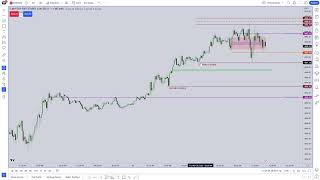
URL: https://www.youtube.com/live/LN1nfYp4dBw?si=DcgaX3L3z3j4Gl81 Watched Date: March 30, 2023
Outline
00:34 - What we’re seeing today.
02:43 - Intraday Volatility:.
07:53 - What is the consideration for the price to close in that gap?
11:35 - The market is one of those markets where you have to know where it’s going and get into something that would otherwise be unconventional.
16:10 - The opposite end of the range -.
22:43 - What happens if you don’t listen? -.
28:48 - I'm making this harder than it needs to be -.
34:37 - Being wrong in a trade doesn’t hurt your ego.
37:07 - Bearish Breakers.
42:53 - Why you need to trust the market structure -.
48:15 - How do you know when the hold on to a stock is going to be broken?
54:30 - The silver bullet is a time-specific setup that forms between 10 o’clock and 11 o’clock.
01:01:09 - What to do if you don’t have a whole lot of time.
01:07:39 - People who don’t want to listen.
01:14:44 - What sets the tone for the market?
01:17:22 - Where does the new week opening gap exist in the market?
01:23:22 - People who know what they’re doing and how to navigate the market are going to do well.
01:28:24 - When in doubt, stay out -.
01:35:04 - Live streaming is not respecting anything, it’s chopping around sideways.
01:41:08 - When it’s going to be a good day -.
01:46:02 - Making money by finding trades -.
01:53:14 - Is the order flow bullish or bearish? -.
Today, we are going to analyze intraday volatility using tape reading, specifically focusing our attention on the 10:00 AM hour. Let's have some fun and identify a five-handle run.
We are observing a Fair Value Gap here in the form of a BISI. Additionally, we have hit the bearish order block from the March 6th opening price—check your daily chart to verify that level. It also coincides with an old New Week Opening Gap low.
I would like to see price attempt to push up into that area further. If we break above 4089.25, I anticipate a continuation toward 4104, assuming we reject any immediate corrections. I am not confirming this is the case yet; I am specifically waiting for the 10:00 AM hour to begin, effectively sitting out the first 30 minutes of the opening range.
ORG
one of the things you want to do is you want to have your opening range like this defined 25% 50% 75% of the range.
SSL below those REQLs if it wants to go lower to close ORG
Watching the blue marked BISI to see if it gets respected as IFVG
If you are experiencing difficulty reading price action or accepting what the market is offering, understand that this is a very difficult environment. In a market like this, you must identify the higher timeframe direction, enter a position that might otherwise seem unconventional, and simply hold it—or alternatively, just sit on your hands.
This discipline is extremely hard for new traders, students, or anyone attempting to make ends meet through live trading. It is difficult to suppress the impulse to trade and simply sit still, rather than forcing setups. The conditions are becoming increasingly difficult due to current events, including the banking situation and geopolitical tensions.
Notice how ES is much more jagged to the upside as it reaches for buy-side liquidity. You need to pay attention to how the highs are delivered relative to the three averages.
While we see multiple higher highs on ES—and I am not concerned with the higher lows right now, I am specifically drawing your attention to these higher highs—we do not see that same action in the Dow. The Nasdaq, however, is behaving similarly to the ES.
🔥
Since we are on Thursday, we must consider the specific day-of-the-week characteristics. The market has been one-sided and algorithmically delivered—it has gone straight up. There have been hardly any pullbacks, just small consolidations followed by continuation higher. That is a very painful train to stand in front of. If you try to short that, it will not be pleasant, as identifying where the move will terminate is extremely difficult. Therefore, you have to demand much more from the marketplace: you need to see crystal clear displacement lower to even consider shorting.
I teach my students that the New York session on Thursday generally tends to create the opposite end of the weekly range. Throughout this entire week, price has been powering higher, digging for higher highs, and reaching the logical levels I mentioned in my Monday analysis video. I have specifically been aiming for the buy-side.
As we remain in this narrow range entering the 10:00 AM hour, this is what I would anticipate. Right now, we are essentially just waiting for the time of day to align with more favorable price delivery.
When I was coming up and learning how to read these charts, I noticed repeating patterns that were not in the books, so I started sharing them with my uncle. I would tell him, "Let's watch soybeans tomorrow with these expectations." However, he would go in and do the exact opposite—he would try to fade the move.
Even though I tried to convince him of the setup, he would trade against it with real money. Afterwards, he would catch an attitude and punish me in our conversations, acting as if I caused the result. When I asked him, "I told you where I thought price was going and you did the opposite—why did you do that?" He simply replied, "Because I want to be able to do this on my own."
When shorting a market that is fundamentally destined to go higher, regardless of what you think you see in the chart, you must remember that candlesticks act like Rorschach inkblots: traders project their own emotional biases and desires onto them. This tendency is amplified by desperation or a gambling impulse, which unfortunately leads to a much deeper and more painful learning curve for most people. The core problem is this ingrained, contrary characteristic where traders want to do the opposite. I understand this because my own strong, contrary nature developed from distrusting all conventional technical analysis, leading me to discount everything, which is why some people perceive me as abrasive.
If we look at the Dow futures real quick, it has really slid lower. This is to be expected, as it was the one market failing to make higher highs. In contrast, the Nasdaq was able to make a higher high, and the ES netted higher highs as well. So, we have SMT divergence after digging a little bit deeper into a premium New Week Opening Gap.
I am not interested in chasing this higher. Even if we know it can go higher, I accept that I will miss that move. I will not engage with it, I will not touch it, and I will not look for it—and I am okay with that. If it goes higher past 4100, I don't care.
I have rules I must stick to. If I am "wrong" because I followed my rules and missed the trade, that is fine. It stings my ego and pride a little bit, but it doesn't hurt. Being wrong does not hurt you. What is painful is doing things wrong in a trade and abandoning your rules. That hurts you because it either undoes the positive discipline you have built in your model or starts the process of developing bad habits. You must avoid those behaviors—feeling impulsive, impatient, or feeling like you just "have to push the button."
The current market environment is highly challenging. While I’ve been in markets long enough to know that difficult, sloppy periods occur where precision is nearly impossible, the situation today is exceptionally complex due to several overlapping factors.
Over the past few years, and especially now, we face increasing geopolitical tensions, potential war conflicts, and economic instability driven by bank collapses. Simultaneously, we are seeing major financial shifts, including the restructuring of the monetary system and the rollout of Central Bank Digital Currencies (CBDCs).
This is amplified by the usual political noise and the general public mood. Everyone seems to be at their wit's end; costs are high, and everyday tensions are intense. All of these external pressures translate directly into a highly volatile and "crummy" market that complicates technical analysis.
We are seeing exactly what I want to see: a move down and away from the 9:30 opening price. This level frames the Opening Range Gap High.
If we had opened lower than where we settled yesterday, that would define the Opening Range Gap Low. That is how I am labeling these levels so we can keep track of the terminology I am using.
We have a high, a low, and a higher high. I am looking past the intermediate highs because, ultimately, price reached this specific high. If you looked at a higher timeframe chart, the focus would simply be on that major high, low, and higher high sequence.
Because these internal highs are contained within the range of that high to that low, I am identifying this structure as a Breaker. Specifically, I am referring to these two down-close candles—that constitutes my Bearish Breaker.
We are currently trading below that gap, which is exactly what I indicated I wanted to see. We are now six minutes into the 10:00 AM hour. Ideally, I want to see price break below that low and leave a new Fair Value Gap. Then, I am looking for a return to overlap with this old Fair Value Gap—which would function as an Inversion Fair Value Gap—nested inside the Bearish Breaker. That is where I would look to trade following a potential Market Structure Shift lower.
Notice how animated this run is from here up to the high. While the parent price swing technically starts at the absolute low, I’m going to run a Fibonacci retracement from this specific low up to the high to define my dealing range.
The reason I’m selecting this particular low is because it initiated a very energetic price run. Although the parent price swing begins lower, based on the fractal price action shown on my screen, I am electing to use this higher low. It is much more pronounced and clearly visible compared to the "rounded bottom" price action below it, which I prefer to avoid.
right now we're still in a premium
what discount arrays exist inside this portion of price action?
That is pretty simple, isn't it? It doesn't require a lot of acrobatics. It is a very simple, straightforward concept: imbalances and liquidity.
We have tried many times—here, here, here, and here—to go higher, and it logically turned. It broke below this area and beneath these relative equal lows, which is the reason why I said I wanted to see price trade below that level.
Some of you are thinking, "Well, why don't you just trust it as a Shift in Market Structure with this one?" You can, but it is extremely aggressive.
If I were using that, I would have already gone short here at the low of that M5 BISI turned M5 IFVG.
There's the shift lower.
Notice also how we were on a five-minute chart and I drew that Fair Value discount array over here. Look closely; do you see how that right there is a refined imbalance? We can now change that and move it to here.
You see that? Well, classic Support and Resistance teachers would say this is support broken here; price comes back, touches the underside of that, acts as resistance, and goes lower. Whenever I see a wick like that, I split it in half. The Consequent Encroachment would be the level I am expecting it to trade to. Sometimes these wicks are a little bit longer and more pronounced, which would require price to go up even further—into and above an old low—while still being able to sell off to lower prices later on.
Regarding that one big candle between this candle's low and that candle's high—I do not want to see all of that close in. So, even if it does reprice higher, I want to see that imbalance remain more or less partially, if not completely, open.
I would allow for and be completely comfortable with price trading back up to as much as 4076.75. When you ask me how to trust a trade—how to know when to hold on because it will continue in that direction—the reality is that nobody truly knows. At any time, the market can be manipulated or railroaded by whatever dynamics are currently in play.
Therefore, you cannot be so married to your idea that you fail to account for the uncertainties and manipulations inherent in the marketplace. Something unexpected—a deep political upheaval, an act of war, or an "act of God"—can happen that no one would realistically anticipate. When that occurs, the market does something entirely unforeseen. You must keep this in mind at all times. Right now, we are in Black Swan season, which means anything unexpected can happen, potentially damaging everyone's models and concepts, causing price to move recklessly for a short period.
The Silver Bullet trade setup will form every single day between 10:00 AM and 11:00 AM New York local time.
You must first anticipate a direction. You then wait for a displacement in that anticipated direction. Once displacement occurs, you wait for a Fair Value Gap (FVG) to form. When it does, you should expect price to trade into it and then reprice toward a pool of opposing liquidity. For example, we have already seen a small, minor five-handle delivery in this outline. The expectation is for you to anticipate this formation in price every single trading day.
The Silver Bullet is a consistent move that will always be there; they will never be able to hide it from you or change it, so there is no reason for you to doubt its existence.
This setup is also a vital way to train yourself in patience, discipline, and sticking to a model based on clear rules—specifically, aiming for five handles.
It is understandable that the marketplace is intimidating for new students. Who do you listen to? Who do you trust? You want to avoid wasting time on teachers who promise you can never lose (they don't exist). I try to be responsible by setting clear standards: You must practice in a demo environment; you are not going to trade with live funds until you decide to do so.
I promise that you will see things in price that are very consistent. These are rule-based, structured approaches that you can study like a laboratory experiment. Contrast this with saying, "Go out there and find some random Fair Value Gap and pick a sell-side or buy-side liquidity pool. Good luck." Ninety percent of people would be confused. Instead, I tell you we are looking at a specific 60-minute time window inside of which you can reasonably find a five-handle run. That is reasonably easy.
🔥
There is a graduation in understanding from one PD array to the next, but you only need one.
Between 10:00 AM and 11:00 AM, you are observing the final portion of the move unfolding for the AM session. This places you right in the heart of the action where Fair Value Gaps generally form. Even if you missed the inception of the move—such as selling short above old highs—you do not need that entry to find consistent setups, just as I taught with the 2022 model.
The AM session essentially runs from 8:30 AM to 11:00 AM (sometimes extending to noon), but this specific hour is crucial. Within this window, there are time-based macros: specifically between 9:50 AM and 10:10 AM. Generally, you will see a price run initiate within that 20-minute span.
You are not demanding that you capture the entire daily range. You are not demanding that it reaches your ultimate technical target. You are only expecting it to give you your five handles.
That is a huge paradigm shift, because many of you are taking this idea and trying to make more of it than it truly is. Will there be times when that move marks the significant high or low of the day and just keeps running? Yes, absolutely. But in the beginning, you do not know when those opportunities will occur or what criteria causes them. That knowledge requires many other things that you will learn progressively over time.
I am reminding you as gently as I can: just stick to the rules I am telling you to stick to. That way, you will avoid being drawn into false expectations that the setup is designed to do much more than it is intended.
You push the button, having no idea what you are doing. You are impulsively trying to trade based on what I am saying in real-time, instead of learning the lessons from watching, listening, and observing the rules and parameters I establish. You cannot learn by impulsively pushing the button; you must learn the concepts first, then go practice with them and look for them without executing actual moves. That is the proper order of things. You do not learn by listening to me and simultaneously trying to execute the trade.
Anyway, the delivery of five handles is the easy, absolutely 100% guaranteed, time-specific setup. If you are a brand new person or someone coming to this channel for the first time, this setup forms so consistently and so routinely. There are so many things inside this model, and it is a complete model in and of itself. Think about what it offers: You don't have a lot of time? No problem. You can do this even while you maintain your day job.
You do not need to be precise about your specific levels. You just need to be correct about the available range. Does the setup offer more than five handles? Because if the market has the potential to move more than five handles, chances are high that you will successfully extract your five.
What do I mean by that? When we were looking at this Fair Value Gap bumping up against this level, I explained my apprehension. If we didn't have these relative equal lows—specifically this low and that low—I was concerned this could be a fake run lower to take out sell-side liquidity, only to rip higher and complete the New Week Opening Gap high.
Because those lows are relatively close, there is significant sell-side liquidity below them. While price did drop below them, I ideally wanted to see this specific low taken out. That would have been my preference. However, an aggressive entry would have been valid right here.
Did it offer five handles? Sure. Did it reach the ultimate sell-side target? No. Does that mean the model is broken? No.
You are operating within these rules with the expectation of capturing five handles. You might not get it. You might watch price, expect a specific setup (like what I was looking for), and it simply might not deliver. Perhaps your limit order doesn't get tagged. You cannot view that as a reason to be upset or feel you wasted your time.
How many future "10:00 to 11:00 AM" sessions are available to you? As long as you have breath, your mental faculties, and open markets, you have countless laboratory experiments left to work with.
Will it take you two years to grow confident in using this model? I don't think so. I believe two to three months is realistic. First, you must review previous data to confirm the validity of what I am suggesting. Once you see that validation, you will feel comfortable investing time in walking forward with tape reading.
You do this for several months until you get bored. When you are bored—meaning you are not emotional, not nervous, and not excited when the market moves in your favor, but completely indifferent to the outcome—that is the only time you should entertain the idea of putting real money to work. That decision is yours to make; it is completely subjective. It would be foolish for me or any mentor to say, "You are ready now." The only defining determination is knowing you are not emotionally stimulated by the result, you are not chasing movement, and you are not trying to fix a bad experience with a win. You are simply following the rules.
This is difficult to understand if you are new because you lack rules and experience. You haven't seen this form in previous data enough times to know that what I said exists every day between 10:00 AM and 11:00 AM.
Here is the process:
- Identify Liquidity.
- Find an opposing Fair Value Gap.
- Bearish: If you anticipate liquidity to be drawn lower (sell-side), wait for displacement lower. This should leave a Fair Value Gap above the market price. You wait for price to trade up into that gap and then reprice down toward the liquidity pool.
- Bullish: If you anticipate liquidity to be drawn higher (buy-side), wait for displacement higher. This should leave a Fair Value Gap below the market price. You wait for price to trade down into that gap and then gravitate toward the liquidity pool.
The setup must offer better than five handles in terms of range. It does not need to actually reach the final target. I am teaching you to look at price while removing the necessity of "being right." Being correct is not the destination; excellence in execution is. That level of excellence has a very small population. The only way you become a member is by doing the things I tell you to do and avoiding the things I tell you to avoid—even though human nature often refuses to listen.
I honestly do not understand why traders feel they must endure painful losses to "join the club." I want students who can proudly say they never had to reset their funds or return to the drawing board. I went through that pain specifically to spare you from it; you do not need to repeat those mistakes.
Often, because of my specific vocabulary or how I carry myself, some of you try to mimic me. You definitely do not want to be a clone of my younger self—I had no idea what I was doing back then. The entire purpose of my teaching is to prevent you from becoming that version of me.
It is doing some wonky things this year. It has been very, very difficult for me to go in and do what I am used to doing—which is catching big runs easily. Just look at this; it demands a whole lot more focus because there is a lot of back-and-forth whipsawing.
Are you intimidated by not knowing what the next candle is going to do? Are you afraid it will rip your face off, or stop you out before running in your favor without you? That is all normal. Everybody thinks like that in the beginning.
However, if you feel that way when you start trading with live funds, you haven't traded in demo long enough. It means you are still keyed up about the results; you still feel the need to be "right." The purpose of demo trading is to determine the time window when you are no longer interested in being right, but rather interested in following the rules. Regardless of the outcome, you follow the rules.
The rules dictate when to take partial profits and how to handle your stop loss. I never widen a stop loss. Once a stop is placed, risk can only be reduced; the stop never opens back up. Never, ever.
If you are in a trade and feel the impulse to increase your risk because you trailed your stop too tightly, it is better to just collapse the trade immediately. Just close it, because you have already lost the plot. I promise that discipline will serve you better than the few times the market might turn in your favor. Most of the time, it won't.
That impulse is your subconscious talking to you. It is telling you, "You've been here before." But because you are wrestling with the need to be right, you commit to the idea that the trade has to work out. You try to impose your will on the market. In a market like this, that attitude will break your arm off. You cannot arm-wrestle the market.
In the beginning, especially as young men like I was at 20, you feel like you can do it all. It was very hard to learn these lessons. In time, however, you will learn how to anticipate these choppy moves and recognize when conditions will be difficult.
You are probably asking what makes this morning difficult, and how I knew to anticipate a difficult session. The tone is set by the fact that we have climbed so far up—not just on the basis of being overbought, but because we traded directly to an old high from March 6th. Specifically, we targeted the Order Block, or the opening price, of that March 6th daily candle. We have moved essentially parabolically since Tuesday, continuing in one direction with no real retracements lower.
I know some of you think all the bad news right now must collapse the market or create a crash. I want to remind you that when Venezuela was going through its downturn and essential collapse, its stock market was still going up. It was not affected by that crisis in the way you might expect it to be a catalyst for a crash. They can take your money from you, and the stock market will still go up. They can make things hyper-inflated, and the market will still go up. Why?
That down-close candle over here—I had that annotated on my chart on Monday evening—is a very good Sell-Side Imbalance Buy-Side Inefficiency (SIBI). The market has reached up into that, and we traded into its opening price.
You take the old order flow areas. Before we even traded up here, you can see that this is a swing high. What you want to do is look inside that swing high: Where does the New Week Opening Gap exist in that order flow? Much like if you look at this old low down here, where does the New Week Opening Gap rest inside that order flow? Where is the New Week Opening Gap in this consolidation?
You are going to see how the market really accumulates algorithmically with that New Week Opening Gap. You are going to struggle with all these different New Week Opening Gaps on your charts in the beginning because you feel like you have to have all of them. You only need to have five—you only need to keep the last five of them. But the secret is in one of them. There are several concepts I am going to teach you, but one of the easiest is this: when you look at old order flow—like this old area of consolidation and the high back here—identify which New Week Opening Gap runs through that. That is the fair value level it is going to trade back up into later on, in addition to the individual Order Blocks themselves.
We have had one-way delivery, and we have completed multiple Premium Arrays. We hit the Rejection Block here (the up-close candle's closing price)—we went through that. We went through the Consequent Encroachment of the wick. We went through the Consequent Encroachment of the SIBI here. We went through all of that, all the way to the low of this candle, which is the high of the Fair Value Gap.
However, it is also the low of that Order Block—which is the up-close candle prior to this displacement. So, regarding that low: we traded to that and through it, trading up to the opening price of that candle here. So we have traded into the body of the Order Block.
And then, inside of this range of this old high, we have a New Week Opening Gap that runs right through it. And that is where we traded to. Now, what has the market really done? Nothing.
So we swept the Rejection Block here—this candle right here. Above that, we went above the Opening Range Gap High, which is the 9:30 AM opening price.
Now we are back inside this Fair Value Gap. It is basically do-or-die now, because we are inside of the Breaker—specifically, a Bearish Breaker. We have the Mean Threshold of that, which could act as an inversion. We also have the old Fair Value Gap here. We want to see how price respects that: does it want to offer support, or does it go through it one more time and act as resistance?
Anybody with real experience who has been doing this for a long time understands that this is really difficult price action. It doesn't stay like this forever. There will be periods in the future when the market frees up and starts moving around a bit more, followed by another period where it becomes very difficult again.
This is where the legends shine. The people who know what they are doing and how to navigate these conditions—this is where they truly separate themselves.
People who are boring—and that is the key word, boring—are the ones who are truly consistent. They are not trying to become flash-in-the-pan success stories overnight or promote "get rich quick" schemes. Generally, these people do well in these conditions because they know how to dial back: dial back risk, dial back leverage, and dial back frequency. That means doing less.
In this environment, less is more, because the probability of you executing correctly—especially if you are new—is slim to none. You compound that risk when you trade incorrectly, take a loss, and immediately try to win it back. You might get lucky doing that in a faster market with an obvious objective, but this is not that kind of market. Right now, it is whipsawing, consolidating, and failing to make obvious runs.
The market is simply sloppy. It goes through phases like this. Eventually, an event will free it up, price will move, and trading will become easier. In better conditions, it is easy to mitigate a losing trade. However, it is not easy to recover from drawdown in these current conditions. It is extremely difficult, and anyone who tells you otherwise is full of shit.
I have been doing this for 30 years. Nobody can honestly tell you this market is easy right now; it is absolutely grinding people down. It is not realistic to expect otherwise. Yet, here you are, brand new, thinking you should have already mastered this by last week.
My best students know that when conditions are like this, they must be careful—almost still, doing nothing but waiting. This means you have to exercise patience and self-control. Because if you cannot do those two things, the market will usher you out the door, and you will be leaving without your money. You will leave your account balance in the marketplace and go home broke.
When you are doubting the trade, you might think, "Oh, I just need to go in here, overcome my fear, and press the button." Well, play stupid games, win stupid prizes. If you do that with your funded account or your live accounts, you will find out that is not the smartest thing to be doing.
You should have listened to your conscience telling you, "I really don't know what to expect, I am uncomfortable, and I don't have the wherewithal to trade right now." You should just turn the charts off—that is exactly what you should be doing on a day like this. Who cares where the market goes? Even if it moves, you likely would never have been nimble enough to get in. I teach with that perspective because I don't want you entering the marketplace with a false sense of security, thinking you can just go out there and slay everything in a market like this.
You shouldn't be in here pushing a button in an environment like this, because the risk is undefined. How are you going to limit your risk? Where is the risk low and defined? Where does it make sense?
Where is the next Draw on Liquidity? I don't know. And if I don't know where the market is going next, how the hell do you think you are going to know it? That is arrogant.
Let me tell you something: five handles a day. I don't care who you are—that is good money.
If you can consistently do that every single day, be content with it, and just stop... who says you have to trade more? Who says you ever have to do anything beyond that?
If that is all you ever arrive at under my tutelage—if that is the limit of what you achieve—that is not failure. You are doing way better than 99.9% of everybody else.
There is a Fair Value Gap on the Dollar Index I mentioned earlier. I see the Dollar going up there, and subsequently, that sell-side at 4071.75 being taken. That is my "gun to my head" idea going into the afternoon.
Will it happen this morning before lunch begins at noon? I don't know. And because I don't know, am I interested? No. How is that for logic? How liberating is that? Since I don't know, I am going to take time away from the charts and spend it with my wife to have lunch.
That feels wonderful to me because I do not feel chained to these charts. As a new trader or student, you think, "Oh, he’s going to leave and the big move is going to happen." There might be a big move early, but guess what? I don't care. I know how to find the easy days. I know when to anticipate them and how to trade them.
You have already seen plenty of that. However, you cannot learn properly without me taking you through environments like this. It sucks that you want to see big runs, entries called, and targets hit easily, but I cannot materialize that. If the market is going to be held in this range, it will be held. You cannot force it.
Hopefully, I will be with you again tomorrow at 9:15 AM for our next live stream. We will attempt the exercise again between 10:00 AM and 11:00 AM to verify if the Silver Bullet setup manifests on a Friday. Be aware that we have news tomorrow, so price action may move around a bit.
Your homework assignment for today is to study the charts and see if we move outside of this range. Specifically, we need to get significantly below this low and this Fair Value Gap, or break above the high of the New Week Opening Gap.
You don't need to be "right" in your trade; you need to be profitable. You need to be able to get out when the market gives you five handles.
It is easy, folks, but everybody else tries to say it is complicated. It is not complicated; it is based on very simple, rule-based ideas. However, you have to be diligent. You must have the rules written out, understood, and you must stick to them.
If you stick to the rules, it isn't hard. It isn't complicated. But when you deviate from them and go against the bias I am suggesting, then obviously it becomes hard. It becomes complicated—but I am not the one complicating it. You are complicating it when you trade against what I am suggesting the market is likely to do.
Keep learning with us.
Get new ICT lessons, study notes and updates as we build V2.