
Live Tape Reading - Conquering Your Fear Of Entries - March 21, 2023
02:33 - Today’s Topic: Pushing The Button. 06:10 - This is not a signal service -. 11:18 - Can we see a five-handle price run from wherever we are now?
URL: https://www.youtube.com/live/hQ379EuyNKQ?si=6hLCgePKBOd1KeNq Watched Date: March 21, 2023
Outline
02:33 - Today’s Topic: Pushing The Button.
06:10 - This is not a signal service -.
11:18 - Can we see a five-handle price run from wherever we are now?
15:54 - This is about teaching you how to overcome fear.
23:10 - What’s going on in the markets today.
27:47 - What is the risk to your account?
30:18 - How do you overcome fear of entry?
37:01 - When you get in front of a chart, you’re chomping at the bit but you’re also scared.
42:04 - Dow has been consolidating since around 730.
46:45 - What’s the down close in that range?
While the 9:30–10:00 a.m. opening range forms, we stay relaxed—no hard-line bias. Let price show its hand. This morning the aim is a simple, low-threshold objective: five handles on ES.
In the ’90s, when I first started trading commodities, I was afraid and unsure of what to look for. That uncertainty surfaced as constant anxiety—Which market? Which timeframe? Which setup? What, exactly, was I hunting?
Today I’ll commit to a single entry method—using a fair value gap. FVGs are among the easiest structures to spot on a chart. Just as relative equal lows tend to draw price as sell-side liquidity and relative equal highs attract buy-side liquidity, these features are basic and visible; they aren’t hiding.
All I’m looking for is a clear signal that price is likely to reach into buy-side or sell-side liquidity. I’m deliberately keeping the slate clean this morning—ignoring everything else—so I can present the opportunity as simply as possible, as if to someone entirely new to these concepts.
We’re opening in premium with a gap above yesterday’s close—an overnight push higher. When the gap is this large, I expect a brief pop to draw in chasers, then a rotation back into the gap. Define the range as yesterday’s regular-session close up to this morning’s open. The objective is simple: trade back into that shaded range, not necessarily a full fill to ~3984.50. I won’t try to pick the top; I’ll wait for price to show a short-term stall and aim to capture a quick five-handle drop into the gap. I’m not looking for longs. This is a working bias, not a hard forecast—price could still press higher or retrace all the way to the prior close. The goal is a small, repeatable outcome that helps dissolve entry anxiety.
When I opened my first account in 1992, I sprinted to fund it—and then froze. The charts read like Greek. I thought I knew what to look for; I didn’t. I was terrified my first trade would be wrong, terrified of taking a loss, terrified of doing it “incorrectly.” No one knew I was trading; I was just a kid with a new account at Fox Investments, paying $100 round-turn per contract (discount shops like Lind-Waldock were ~$37). I had only $2,500—severely undercapitalized—so I felt I had to be right on direction and right on entry with almost no drawdown. Commissions hit immediately, so in something like soybeans I needed at least a 2-cent move just to cover costs ($50 per cent, similar in feel to $50 per point on the ES). That math loop fed the anxiety until I was a deer in headlights. This is about learning to overcome that fear—not about turning me into your signal service.
I hear from traders who’ve blown multiple demo accounts and become so anxious they can’t even press the button anymore. That’s the result of overvaluing perfection in the outcome. Early on, the job is reps—simple drills and structured exercises. Learn to enter a move without fixating on profit: manage the first-trade fear and let process, not outcome, lead.
I’ll also present opportunities that ask you to think. I’ll point to a place on the chart and have you conceptualize what it represents and whether it justifies an entry—separate from the ones you’ll see me actually execute. That judgment is a skill you’ll build over time.
We’re only looking to frame a simple five-handle move. The first question is: how much risk is appropriate for that? In the beginning, treat this as an entry drill in a demo or paper account and use a single contract. The goal is to dismantle fear. Most anxiety is leverage wearing a mask; the quickest cure is to cut size. Start with one contract and desensitize yourself to execution—the same five-point run is the same pattern regardless of size, but the stress changes with leverage. As you gain competence, scale slowly: two contracts, then three, then four, eventually—if your process remains calm and rule-based—larger clips. By that point you’ll have enough repetitions with live-feeling price action to recognize the sensations of potential loss and gain and handle them with discipline instead of fear.
If your broker lets you lever to the moon, don’t. All that does is raise the odds you blow up, lose, and feel afraid the entire time you’re in a trade. You want trading to be boring—no excitement, no adrenaline, no fanfare. Strip out the emotion so your attention stays on price action, not on how much you might make or lose. Most new traders treat it like a lottery ticket, maxing size and hoping luck carries them. The smarter path is tiny risk, many repetitions. Keep the position small enough that you can take a lot of trades and stay in the game long enough to reach the outcome you’re after. This is not “get rich overnight”; it’s controlled, repeatable execution.
A rising dollar is a near-term risk-off cue—it typically makes it easier for foreign currencies and equity indices to trade softer and lean lower. It does not mean we can pick the top in the dollar, and it’s not a signal that risk assets will crash.
All we can say is that it puts things in motion that are likely supportive of weaker, lower prices. We’ve already gapped higher and had the initial leg up; now we’re consolidating. Breakout traders who buy the first break are already in from this move.
Dropping down into 5-4-3-2-1 minute charts now:
Today’s exercise is about waiting for a real opportunity—there’s nothing here yet. As a rule of thumb, submit to the first 30 minutes after the New York open (9:30–10:00 ET). Reports can drop around 9:45, and the first burst is often a Judas swing that lures gamblers before reversing. Relax. You have the whole day to find a small, clean objective; don’t rush just to “get it over with,” or you’ll condition yourself to fear the process.
My early barrier was entry anxiety: I didn’t trust the model because I hadn’t seen it enough, so I wanted to grab something fast and run. That mindset breeds avoidance. Instead, run drills on demo, review every attempt, and don’t hide the mistakes—study exactly where you were wrong so they don’t repeat. Preservation of capital comes first, whether on paper or with live funds. Submit to the opening half hour, let the market tip its hand, and only then act with purpose.
The initial drill is simple: five for five. Risk five handles to make five handles. Despite what some believe, this can make money; profitability doesn’t require 5:1, 10:1, or 20:1 reward-to-risk if your strike rate is solid. While you’re training, a 1:1 framework is enough because the goal isn’t to chase giant multiples—it’s to condition yourself.
This drill desensitizes you to outcome fixation, helps you step into trades without the fear of missing a move, and reduces the anxiety of taking a loss. You’re practicing execution, not perfection. Stick to one-for-one while you build consistency and let the process, not the payoff, retrain your mind.
We’re still in the first 30 minutes of trading—by design. I’m asking: What am I looking for? What am I waiting on? What should price show? Where is my focus? What don’t I like? That’s the exercise. This is mentorship: learning how to look, not blindly jumping into a trade.
Devil’s advocate: if price breaks lower and I’m not in, I’ll frame an entry off the top of the shaded range and the wick’s midpoint (consequent encroachment). If it trades down without taking the low and then retraces into that zone, I’m fine using it as the entry. You may not be—that’s okay. The point here is overcoming entry fear, not forcing a model on you. I’m deliberately waiting for a fair value gap to form and using that as the trigger. There will be one every day; the real hurdle is patience. Since none has formed here, I’m not short—because there’s no FVG.
I don’t like where ES is right now. We may need one more push higher—Nasdaq looks ready to flirt with a higher high—while the Dow is dull at the moment.
On Nasdaq, price has formed relatively equal highs—a clear buy-side liquidity pool—and a run up to tag that area is likely.
This is the phase that punishes new traders. You show up determined to push the button—amped, impatient—and at the same time afraid of being wrong. Every thought becomes a second-guess, and urgency pushes you to “do something.” That’s the trap. Carry the discipline you built in demo into live markets and lean on that experience, or you’ll default to impulsive clicks. Wait for a defined setup in the chart and a clear reason to act. This isn’t a coin flip—no entry without a valid signal.
Price may push toward 4028, but I’m not chasing that move. Today’s focus is a fair value gap entry—nothing else. One will form; my job is to wait, ignore the noise, and exercise the discipline to sit through every other fluctuation until the market offers the setup.
I don’t care how many trades people post on Twitter. That isn’t my trade, and it isn’t yours. You can’t rewind and enter where they did—if it even worked. Submit to your own learning process.
Still very mixed—typical ahead of FOMC. Be nimble and lower expectations. We gapped up at the open, had a brief pop, then eased lower without real downside energy. Inter-market reads from the dollar quickly canceled the short.
DXY has returned to the m1 BISI and already tagged the BISI low. If the dollar rallies from here, the ES high looks suspect—likely just a buy-stop run.
I’m scanning EURUSD, GBPUSD, and the Dollar Index as a triad. Their relationship gives me a read on market tone—risk-on or risk-off. I’m not watching EURUSD to trade it specifically; I’m using the inter-market alignment to gauge risk and set bias.
ES has slipped back below the recent highs while the dollar firms, which favors a downside read. I’ll wait to see if that high holds. If price breaks lower and leaves a fair value gap inside the current up-leg—between the swing low and the newly printed high—I’ll key off that gap. The leg has already raided buy-side liquidity (protraction), so I’m anticipating a corrective move; if the FVG forms within this leg, that’s the one I’ll use.
If we were applying Turtle Soup, that run above the prior high would be the setup—fade the breakout and short into it. The tell was intermarket divergence: Nasdaq and ES printed higher highs while the Dow failed to confirm, making the squeeze above the high a short.
I want this candle to print a fair value gap here. I don’t want an immediate rebalance—I want this candle to close, the next to open, and price to hold without taking out that low yet.
You have two choices here. Place a limit at the prior high plus one tick with a 5-handle stop and a 5-handle take-profit, or wait for price to trade back into that level and accept the risk of no fill if it keeps running. Missing a move is fine—you won’t catch them all, and neither do I. A breaker has now formed.
A breaker forms after a sequence of high → low → higher high that raids buy-side liquidity. Shift your focus to the down move preceding that second higher high—the low between the two highs—and mark the down-close candle(s) within that leg. That entire down-close range is the breaker.
If price rallies into the fair value gap, the short is valid—but fold the overhead breaker into the setup. Price can push through the FVG and wick into the wider range of the breaker (the down-close range between the two highs) before reversing. Use the FVG as the entry, treat the breaker as the tolerance band, and place the stop beyond the breaker/down-close so the inevitable probe doesn’t knock you out.
Liquidity sits just below 4014.25: the cluster of relatively equal lows houses resting sell stops. If smart money sold short into the run-up—selling to those buy stops—the efficient exit is to buy back lower from the sellers triggered beneath those equal lows. That’s the Market Efficiency Paradigm: sell into buy stops at a premium, cover into sell-side liquidity at a discount.
One of the first disciplines at entry is precise stop placement. Confidence in the target doesn’t excuse sloppy risk. Don’t chase; for shorts, trade from premium, not discount. A simple filter helps: sell into up-close candles and buy into down-close candles. That single habit often improves entries more than you expect. Even when you’re convinced price will reach your level, let the trade come to you, define the risk with your stop, and execute from favorable terrain.
Enter, then submit to the plan. If it tags your stop, fine. If it runs, fine. Treat it as one clean experiment. What matters next is time: how long it takes to show movement in your favor after entry, and how quickly a loser fails. Log both. Over many samples you’ll learn your model’s “time to prove” window, when you’re late, and when patience is warranted. Define the window in bars or minutes before the trade; once the clock is set, honor it—no second-guessing, no tinkering.
I’m taking the entry from a fair value gap, framed by the breaker for context and confluence. After entry, I want to see price trade through the small volume imbalance and, once below it, avoid reclaiming it. Risk is reduced by tucking the stop just above the breaker so a stop-out is minimal. From there it’s observation: does order flow keep delivering toward the resting sell-side liquidity at the recent low?
Note in your journal when you’re trading ahead of FOMC. That climate is not built for high precision or easy, low-resistance liquidity runs—the “salad days” aren’t on the menu. Still, you should practice in these conditions. By training here, you condition yourself for the best days—when the market is freer to move, when drives into expected levels are cleaner, and when momentum tips its hand.
What I’m after, and what I teach my students to recognize, is a signature: a sudden, one-sided push that digs into the draw on liquidity. That’s very different from “the market is moving so I’ll try to make money.” Motion alone is not a setup. The bar is higher: wait for intent, velocity, and alignment with your model, then execute.
remove the stop after running close to a new pool of liquidity (SSL)
I’m not concerned about continued upside—the overnight session already did the heavy lifting. This zone is a trap: it invites late longs who “missed the initial run-up” and bears who short with stop-losses just above the initial RTH high. Price then drops into the opening-range gap (ORG) high and rallies, frustrating both sides, before the real move: a run toward fair value. Since RTH opened in premium, some degree of rebalancing is expected. We also had REQLs as the SSL target, and once the ORG high was pierced, everything aligned for the short: SIBI + BRK-.
I used the dollar index as a filter and it kept me from jumping in early. The intermarket read wasn’t risk-on, and the structure wasn’t compelling—no clean alignment, no urgency. That’s where experience pays: you recognize when the picture lacks confluence and you wait. The bias can be correct and still be a bad trade if timing and structure aren’t there. I let DXY confirm the backdrop, respected the missing pieces in price, and stayed patient until the market tipped its hand.
I saw clear index divergence: ES/NQ poked higher while the Dow failed to make a higher high. That non-confirmation told me the upside was likely exhausted—more buy-stops than real strength—so I leaned short and used the breaker (the down-move between the two highs) as my entry reference. It gave me clean structure and a defined invalidation, so I trusted we wouldn’t extend higher.
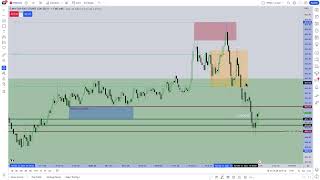
The red shaded zone is where smart money sells into strength, planning to buy back lower. Who sells to them down there? Retail traders who mistake the cluster of relatively equal lows for “support,” go long too early, and park their stops beneath it. Price is drawn to that pooled sell-side liquidity, runs those stops, and hands smart money the buy orders to cover at a discount—classic market efficiency paradigm.
if your model is 2022 model - you watched me execute that model here
You get over the fear by submitting to the model. Start by defining the protraction—the impulse leg that just ran liquidity. As price begins to retrace, ask one thing: did it leave fair value gaps? Mark every FVG inside that leg. If there are several (say, two), the 2022 rule applies: treat the highest one in that leg as your invalidation for shorts (the lowest one for longs). Enter on the first clean return into an FVG; place the stop beyond the higher FVG (for shorts) or beyond the lower FVG (for longs). Now the outcome is binary and boring: either price respects those gaps and delivers toward the draw on liquidity, or it trades through the invalidation and you’re out. Risk is predefined, execution is mechanical, and fear has nothing to feed on.
If price prints a higher high and tags my stop, that’s fine—it’s new information. That move cancels the bearish SMT on the Dow and invalidates the short, so I flip the bias and hunt longs for the rest of the day. If the short thesis were valid, it shouldn’t have failed there. One stop-out becomes the signal, not a setback. This is exactly why I never over-leverage a single idea: I keep capital (and attention) intact so I have the ammunition to participate immediately once the market reveals the correct side.
Define the current micro dealing range. Prefer shorts in the premium—the upper half of that range—and only on a valid short setup. Manage to flatten in discount: take a partial at EQ and complete exits as price reaches the lower half/liquidity. If, after entry, price reclaims and holds above EQ, reduce risk or exit—rotation is likely shifting against the short.
While you’re practicing, feel free to frame a setup for more than five handles, but the moment you’re up five, flatten the position. Bank the win, desensitize yourself to the outcome, and watch the rest of the move without the emotional drag of open risk. This habit trains your nervous system, protects capital, and sharpens your read of price.
Keep learning with us.
Get new ICT lessons, study notes and updates as we build V2.