
ES Tape Reading AM Session - February 13, 2023
01:09 - The US 500 and ES charts. 06:05 - Looking at the US 500 chart. 11:10 - What stands out with the relationship between the nas and the ES at the lows of the day so far?
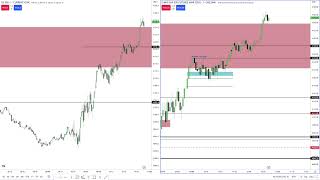
URL: https://www.youtube.com/live/dwJcsi3ddFg?si=gprYzo3oaIog2tvf Watched Date: February 13, 2023
Outline
01:09 - The US 500 and ES charts.
06:05 - Looking at the US 500 chart.
11:10 - What stands out with the relationship between the nas and the ES at the lows of the day so far?
14:52 - What are you looking for in this candle?
19:20 - What makes a bullish breaker?
25:07 - Why you need to be more selective in what you trade on.
29:24 - What would you have liked to have seen?
33:18 - What are you looking for in this chart?
38:13 - When you have a group of people that come into this, it’s going to get a lot of low resistance.
45:06 - Fibonacci levels are moving towards these levels.
51:26 - What is high resistance to high resistance liquidity?
57:42 - When you’re forced in front of these charts, they are a mirror -.
01:02:20 - How do you know when you’re first learning? -.
01:07:35 - Each one of these are a laboratory experiment, they're teaching you how you're going to feel without any money.
01:13:23 - You want to have that in your journal because you don’t want any opportunity to criticize yourself.
01:20:47 - You're looking at these candlesticks and you're manifesting the argument that you just had a breakup.
Be mindful that the ES is trading above Friday’s close, indicating a premium relative to the opening price versus Friday’s close. By this, I mean that the gap up from Friday’s lower close will usually trigger some kind of pullback into the price action.
➡️
Many traders are sitting on their hands today, not worrying about the market, because they know tomorrow will bring significant movement. There will be strong price displacement, creating sentiment shifts, big runs higher or lower, inefficiencies, fair value gaps, and liquidity sweeps above and below the marketplace. That’s where the real interest lies. You want to wait for that displacement—like watching a smooth pond until a rock is thrown in, creating ripples and real action.
In my opinion, if our industry didn’t have the uncertainty of today versus tomorrow’s CPI release, we’d likely see more movement. With the economic calendar in view, you’re always looking ahead, preparing for risk and anticipating where volatility will come in. You need to set expectations well in advance of CPI day. It might create plenty of opportunities, but for me, risk is dialed back. My interest in taking a setup becomes much more selective. I only want to trade very specific conditions because today’s environment isn’t likely to deliver with the same precision I’d normally expect. Fewer participants are active now, but once CPI drops tomorrow, there will be a rush of traders chasing moves.
➡️
Before the high was taken, he wanted to see the volume imbalance get traded into and hold as support, signaling strong intent to move higher.
After the high was taken and price had already moved up, he no longer wanted to see the volume imbalance revisited. Instead, he expected two consecutive down-close candles to serve as support structure and function as order blocks.
➡️
What you’re going to do is draw your Fibonacci from the low up to the wick’s high to set objectives, since wicks can be used for measuring ranges and targets. The only time I use a wick for entries is when applying consequent encroachment or the quarter point of that wick—those are the two most important levels for me on a candle’s wick.
You’re managing and developing patience. When tape reading, there’s no excitement or emotion in my voice—I’m not shocked, and I’m not risking anything. I don’t care about being right or wrong. All I’m doing is pointing out where the market is likely to go when it fails to do certain things. I’m simply observing and sharing what it should be doing, and what it shouldn’t.
➡️
We had a retracement into this BISI. The sell side was offered here on this candle, with its low just one tick below the BISI low. That’s permissible and reasonable—it doesn’t disrupt anything. But it also reflects the signatures of a day like this, where precision is slightly skewed because tomorrow is the real event(CPI), the one everyone is waiting for. On days like this, the price action won’t be as clean or perfect—similar to why I avoid trading on Thursdays and Fridays leading into Non-Farm Payroll.
I view that as engineering liquidity. REQHs were left.
Look at all the back-and-forth here—see that? To me, it signals a balanced price range. As much as I’d like to see this BISI remain open and serve as a breakaway gap, if I had entered long from down here, I’d prefer it to stay open and allow for re-accumulation of new longs above these highs. Still, I have to accept that the market has now priced in a relatively equal high.
If they take out the short-term low here, price can return to this level. That’s one of the reasons I teach not to trail your stop loss too early—you don’t know when these fair value gaps will form. As a newer trader, you have no way of anticipating them. I usually have a solid idea of where they might appear because I’m familiar with the range I’m trading and can recognize signatures, like those I taught last week. Using the PD Array Matrix, I know when price is in a premium or discount. Just as there’s a threshold where you avoid adding new pyramid entries, there’s also a threshold you want price to surpass before even considering moving your stop.
🔥
Important information about the INEFFICIENCIES
If price goes through consequent encouragement and expands, the probabilities will always favor it reaching the high end.
You’ll find that standard deviations serve you better than the classical Fibonacci approach. Over time, once you understand the narrative of where price should go with liquidity, combined with inefficiencies when they exist in price.
A breakaway gap is a signature move where price snaps higher with no immediate intention to reprice over the area left behind. This often signals the potential for speedy moves in price. However, in this case, we reached into a 15-minute premium fair value gap and nearly touched the lower quarter level of it. When price continues to revisit this area, it creates hesitation.
This behavior is also why I stress caution on days before major news events like Non-Farm Payroll, FOMC, or tomorrow’s CPI release. The market often delivers in a frustrating way—quick moves up or down, followed by choppy, indecisive price action. You’re left wanting the trade to just reach target and be done, but ahead of such high-impact drivers, conditions usually lean toward high-resistance liquidity runs rather than smooth, clean moves.
For learning purposes, this is what it looks like when price delivers under high-resistance liquidity conditions. These signatures can be extremely frustrating before the market finally reaches your objectives. All of this back-and-forth is what you’ll endure if you force yourself to trade in such environments.
High resistance here doesn’t mean support and resistance. It means the market is resisting clean, efficient price runs—those big, fast moves that quickly reach your target. That’s the kind of environment you want to trade in.
But as a neophyte—or even as an experienced trader who’s never really studied price action this way—you may not have paid attention to these differences. Sometimes the market gives you stagnant, grinding conditions. If you keep a wide stop from your entry and never move it, you might still hit your targets eventually. But if you’re sitting in front of the chart, watching every single minute candle unfold, the process will feel painfully frustrating.
This is a high-resistance liquidity run condition. This is what we can expect, and it’s what you’ll have to endure to truly feel what it’s like. Price takes a lot of time, moving very slowly and lethargically within small ranges before finally clearing pockets of liquidity.
There’s no immediate gratification in conditions like this. In low-resistance liquidity runs, you get that instant feedback that you’re on the right side of the market. Price doesn’t waste time consolidating—it moves with urgency, racing toward its destination. When you’re aligned with the market in those conditions, there’s nothing more satisfying.
We got very close to the buy side, then pulled back down to the low end of the fair value gap. This is exactly the kind of price action you want to record in your journal. Don’t write, “this is so damn frustrating.” Instead, note the amount of time it takes and whether it ultimately leads to a failure.
That’s the problem you’re going to face trading in these kinds of environments, compared to when the market is clearly set to move in one direction. When it’s one-sided, that’s how I define a high-probability trade—one that can only be justified in one direction. Those are the easy days: you get in, take your money, and you’re done.
But in these environments, you have to work for every inch. Even if you end up profitable, you’ll feel drained—like you’ve been through a workout. By the end, you just want to rest, not even look at another chart. That’s because you’ve been burning mental energy, running countless “what if” scenarios: What if I don’t take partials here? What if I move my stop? What if it reverses and takes 40% of my profit? What if I take profits now and it keeps running without me?
That’s exactly what you need to observe, and why I walk you through these charts. Because this process becomes a mirror—it shows you who you really are as a trader. You may think your discipline and willpower are strong, but markets like this will expose weaknesses and force you to refine them.
It doesn’t mean you’re a bad trader. It means you have areas to improve, and you need to develop coping mechanisms for the traits that can hurt your performance. What might seem like harmless quirks in everyday life can become liabilities in the markets. Recognizing and managing them is what separates a struggling trader from a refined one.
You’d want a screenshot of this as part of your journal. Treat it like any other chart note. Record how much time you spent enduring the move, watching price return to the levels I outlined. Document how it respected the classic characteristics those PD arrays should deliver in price.
Notice how price came down into this down-close candle—right on it. Make sure you annotate that. Also note how the candle pressed into the low end—that’s perfect. Even in high-resistance conditions, the precision elements I’m teaching still apply. The difference is that you’ll experience a lot more chop in between those precise touches.
Sometimes price will color outside the lines, like it does here or here—and that’s fine. As I explained last week, think of it like cutting the grass: when you turn around, you overlap the section you already cut with the section that’s uncut. That way, you avoid leaving seams or strips of grass that are still too high.
That’s what the market is doing here—slightly overshooting the fair value gap to make sure there’s no seam, no leftover imbalance. It overlaps just enough, and that’s what makes it institutional order flow.
Since I’m already entered (tape read setup), I want to see this level stay open before we get to preferably into the consequent encroachment.
For me personally, this would close my morning session. I’d be done. I’d close my trades, square everything, and relax for the rest of the day. Maybe watch some Netflix and chill. Enjoy the time away from the charts.
Don’t force yourself to chase another move just because there’s time left. It might only be 10:30, and yes, there’s still plenty of day ahead—but that doesn’t mean you’re wasting time by not trading. Pushing too hard is dangerous. You may have an edge right now that I’m helping you refine, and when I say stop—close the charts and walk away. If you ignore that, you miss out on building discipline, patience, and overcoming the fear of missing out.
I don’t care what the market does for the rest of the day. I don’t care. Because I know what I use and what I teach all of you repeats every single day. I also know there are times when the market simply won’t favor me to participate. We’ve seen something unfold this morning, and it’s not about being right.
Listen to me—each one of these is a laboratory experiment. They’re teaching you how you’re going to feel without any money at risk, without any right or wrong. Every time I talk to you like this, who’s at risk of being wrong? I am.
This frees your mind from all that concern. You get to watch me operate without a safety net, applying the very concepts I’ve taught on my YouTube channel and proven effective. I’m showing you that these methods absolutely work, and there will be periods when you simply won’t know what the market is going to do—and that’s okay.
Not knowing what will happen is part of the process. If you just sit and wait for the market to tell you what it wants, you’ll miss the lesson. Even in high-resistance conditions like this, the market is likely to deliver to our levels, but you must endure more pauses, retracements, stagnation, and consolidation before it gets there. That’s what I want you to focus on and annotate in your charts and journal.
Don’t write things like, “This was stressful,” or, “It was hard to sit through.” Instead, say things like: It was surprising to see how much time the market required to reach our levels, or I observed how price trained to our levels. Always frame your notes in terms of observation and anticipation.
Even when you’re recording my live calls, you should write in your journal as if you anticipated it yourself. For example: I’m pleased that this fair value gap supported price and only went down partially, just as I expected. I’m satisfied that PD array performed as anticipated. This way, you internalize the process, not just passively watch it.
You run your business with models that tell you how your costs need to stay within a certain range—whether that’s ingredients, overhead, or labor hours. If business slows down during peak hours, you need to know what constitutes normal fluctuations and when you’re outside those boundaries. Then you can relax, trim overhead, send people home, and avoid producing more than you can sell.
In trading, you’ll develop your own KPIs—personal benchmarks for efficiency, productivity, and mental capital. It’s simple to research, and it gives you a baseline to measure your growth as a student of the market. Think of yourself as a corporation, a Fortune 500 in the making. You can’t reach that level if you’re lazy or unaware of how to manage yourself, evaluate your baseline performance, and measure how much mental capital you spend worrying over charts.
By following these daily exercises, you’ll gradually spend less mental energy than you would without structure. If you don’t have someone experienced guiding you, coaching you through the process, and showing you what should happen, it’s easy to feel uncertain. This morning, you probably felt confident following along—even if, deep down, you had doubts—because I was there guiding you step by step.
You want to filter out all negativity and self-criticism. Don’t give yourself any opportunity to question what you expected to see in price when tape reading or taking live trades. When you record annotations on your charts, make them succinct and specific—focused only on what you anticipated and perhaps what you didn’t.
While learning with me in these tape-reading sessions, understand that you didn’t catch everything I said. That’s normal—you were likely preoccupied with whether you should have taken a trade or looking for reasons why I might be wrong. Focus on the observations, not the doubts.
You don’t want to skip over the opportunity to record your observations from the perspective that you had already anticipated them. At first glance, this might feel disingenuous—it might feel like you’re lying to yourself. But this journal isn’t meant to be shared with anyone else. You’re not lying to anyone; you’re using a purposeful technique called positive self-talk.
By visually recording price action and what you observed, you engage your reticular activating system, priming your brain to recognize the patterns in real time. You may not have noticed certain things on the chart before I highlighted them, but over time, your subconscious will internalize them. Recording these insights as if you anticipated them yourself reinforces learning and builds confidence.
Don’t just write it down and forget it—review it at the end of the week. Read your annotations out loud. Hearing your own voice will gradually replace mine in your mind. Right now, when you watch price action, you hear me saying, “This is what the breaker does,” or “This is what the fair value gap does.” Over time, your own voice will take over, fostering independent thinking.
I want you to think for yourself, not act like a robot following instructions. These ICT “training wheels” are just a guide. Positive self-talk and the absence of self-criticism are essential—never add negativity, even if a trade hits your stop or goes against you. Harmful self-criticism is absorbed by your subconscious and can take years to undo.
Even after years of experience, I still feel those early fears surface occasionally. But I remind myself: those are ghosts—they cannot harm me. I acknowledge them, but I replace them with positive self-talk: “Yes, that happened. I got a scar, but I’m still here. I’m still able to trade, still able to teach, still able to perform.”
By consistently providing yourself with a supportive, positive learning environment, you reinforce growth, resilience, and confidence in your trading abilities.
Think of it like those high school lab experiments in biology or chemistry. You had a lab partner, right? More often than not, that just made you anxious and emotional because you were comparing your productivity to theirs. At the time, it didn’t seem like a big deal, but that experience taught you how divided attention can disrupt focus. Two conflicting mindsets rarely work in harmony.
Now, translate that to trading. You’re watching candlesticks, but your mind might still be juggling other concerns—arguments with a significant other, a missed promotion, feeling unwell, or realizing you haven’t spent enough time with your family. Personally, I’m thinking about being punctual this morning because of promises I made, and I’m planning for my anniversary on the 14th—which also happens to be my son Cayman’s birthday. There’s a lot on my mind, yet I have to maintain focus on the charts.
The point is that trading requires compartmentalizing—recognizing outside distractions but not letting them interfere with your analysis. You’re learning to stay present, to observe the market objectively, despite everything else going on in your life.
So, are you going to be able to focus? Maybe not fully—and that’s okay. The real question is: are you willing to make that decision for yourself and your trading? Can you accept that today might not be the day to trade because there are other, more important priorities in your life that need your attention?
If you ignore those responsibilities, they become a festering distraction, pulling your focus away from the charts through guilt or regret. Managing yourself as a trader isn’t just about reading price action—it’s about managing your life, your mind, and your priorities. That’s why developing your internal analyst is so important, and that’s exactly what I’m teaching you: how to cultivate the analyst inside you.
Boom. Screenshot that. This is exactly what it feels like—when you know what you’re doing and understand why price is going to move the way it does. You’re done. You don’t care if it surges all the way to 4150; you simply close up shop, annotate what you need to annotate, and walk away for an hour.
Breathe it in. Right now, you just watched price behave exactly as you anticipated. That feeling isn’t something you get from a video or a book. It’s not the same when you follow someone else’s trade—you know in your heart you didn’t earn that result; you just copied. And that can feel frustrating because you want to achieve it yourself.
For some, copying may be necessary—and there’s no shame in that. Everyone has limitations. I could never live with myself doing that, but I also recognize that some personalities are just not naturally equipped for this kind of trading. Not everyone watching this will be able to train this way. When I stop the live sessions in November, it might feel like a loss for some—you’ll no longer have that live guidance crutch—but this is where you either step up or adapt.
Keep learning with us.
Get new ICT lessons, study notes and updates as we build V2.