
ES Review & ICT Funded Challenge Discussion - May 04, 2023
ICT reviews ES price action during a seasonal May bearish window, breaks down volume imbalances, New Week Opening Gaps, and the price delivery continuum — plus a funded challenge discussion.
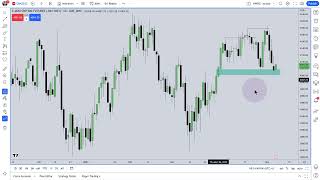
YouTube: https://youtu.be/F509lJRrYIM?si=KRNYEpOwJ2sGbDgM Watched Date: May 5, 2023
Seasonal Tendencies — May into June
Every calendar year, from May going into the first and second week of June, ICT favors shorts in stock index futures. This aligns with the well-known saying "sell in May and go away" — a seasonal expectation that stock prices tend to descend during spring heading into June.
I've been following the markets for three decades. And I can tell you, there are certain seasonal tendencies that are just really, really strong. And one of them is this may influence going into June. So if you are looking for a way to like dial in a very specific time of year to look to be a trader, or learn to be anticipating specific things in price action, there's no better one than being bearish and spring going into summer months. And then being long in the fall months going into the end of the year, first week of February. So that tendency is not just being mentioned here. If you go on my core content lessons that I've uploaded here on YouTube, you'll hear me talk about those very things. And they keep repeating every single year.
Having followed the markets for three decades, ICT emphasizes that certain seasonal tendencies are exceptionally strong. One of the most reliable is this May-into-June bearish window. Similarly, being long during the fall months — heading into year-end and through the first week of February — is another high-probability seasonal bias that has repeated consistently year after year. Don't limit this study to recent years; go back as far as possible and examine older data. You'll find that seasonal tendencies act as a higher timeframe roadmap for where significant price moves are likely to form. Seasonality alone is not a panacea — futures markets carry no guarantee of repeating past performance — but when a tendency repeats more often than not across many years, it warrants deeper investigation. Adding technical confluences to seasonal bias is where the real edge lies.
Price Action — Liquidity & Inefficiency
I want you to look at how we have had this high here. It traded above it and created a swing high, which is a candle with a lower high to the left of it and a lower high to the right of it. When we see that, we anticipate price to try to drop lower. It does — it goes below this swing low, which is a low with a higher low to the left and a higher low to the right.
It goes down below that into this inefficiency here, which is a Buy-Side Imbalance / Sell-Side Inefficiency — a classification for a specific type of Fair Value Gap (BISI). The market trades down into that, creates a swing low, then rallies back up and swings above this swing high.
So above this swing high — buy side. Below this swing low — sell side. So we've had: High, Low, Higher High, Lower Low, Higher High, Lower Low.
In terms of looking at price action, I want you to look at how the market gravitates toward liquidity and inefficiencies. Those are the only two things the market will do. If it doesn't do either one of those things, it will go sideways and consolidate until it meets a criteria that allows it to do one of those two things — which is go up for buy stops, or go up to an inefficiency. What does it need to do to make this inefficiency efficient? It needs to offer price going down.
On Tuesday and Wednesday, the market repriced up to this H1 SIBI and shot up into it, in between the imbalance that formed here. The market traded up and then aggressively broke lower.
New Week Opening Gaps
Try to have at least five of the most recent New Week Opening Gaps. It's important to have them in your journal — every time you have a new Sunday opening of a new trading week, on your Sunday journal entry always record what the opening price is and what the previous Friday's closing price is. That way you always have the information ready at your fingertips.
I would have the opening range of the first 30 minutes and the first 60 minutes at midnight for all the markets that are traded. That idea can be applied in multiple timeframes throughout the sessions — the Asian session, the New York session, the London session, and the PM session in stock indices.
Don't Use the Kitchen Sink
Just because I'm teaching something, or taught something somewhere else, don't think you have to reach for everything I've ever talked about and try to apply it to current price action. That's not what a model is. That's the kitchen sink approach — trying to apply everything to whatever you're studying, and that's too much. It'll create analysis paralysis where you really won't know what to do, the information becomes too much, and many times the ideas may conflict with each other and it becomes frustrating. So you want to limit your focus to a specific thing or two within a bias. That's all you're going to do.
Non-Farm Payroll Guidance
New traders or new students should not be trading on Thursday and Friday of Non-Farm Payroll week — it's very difficult for a new trader to navigate that environment and they don't have the skill set yet.
NFP is generally the first Friday of every month. That day, you should mark it off as a no-trade day. After the Non-Farm Payroll numbers come out, if you want to take some action, then you decide whether or not you want to do that. But you should not be trying to trade the Non-Farm Payroll event itself, because it can do all kinds of wild things and hurt you.
H1 Chart Analysis
That's a bearish order block.
4H Chart — Swing Low & Daily BISI
On the four-hour chart, go back to this — this is the swing low with sell-side below it. We got real close to the bottom of that Daily BISI.
If price were to get below that daily imbalance, this would be the next discount array if we were to trade down through it.
Volume Imbalance
There's the volume imbalance — the candle's body closes up, and then the next candle opens right here with no wick; the open is the high. That separation right there is a volume imbalance. That means the algorithm has not offered price to the marketplace efficiently between these two price points. It's kind of like a micro Fair Value Gap, that little area right there.
The algorithm is designed to offer the marketplace efficiency in terms of a constant continuum of both buy-side and sell-side. In layman's terms, every price is offered at least two times — once on the pass down going lower, and once coming back. Once it passes down through a particular price range or level, and it doesn't offer a body in that range, the algorithm sees that separation between these two time intervals. The algorithm is constantly cycling from a higher timeframe down to the lower timeframe in such a fine level of detail, looking for these little pockets, doing it so fast in terms of calculations. It's constantly going through a script seeking these things.
What happens is — because there are participants always coming out wanting to place market orders — the algorithm simply fills price toward the orders it knows are there. As soon as an area of buy stops gets hit, those buy stops become market orders to buy. Whenever a pool of buy limit orders gets triggered, those limit orders become market buys, just limiting how much they're willing to pay on the limit basis — but they immediately become at-the-market orders.
That's why you're seeing that little movement just above it — because the algorithm gets that closing price perfectly and drives it one tick above.
Price Delivery Continuum — Two Passes
Between this closing price here and this candle's opening price, there has really been no trading. In my view, the algorithm sees these wicks the same way we as humans see that gap.
So what does it need to do? It needs to pass through two times. The market trades up through that price point — always think of that shaded area. We traded from the low of it all the way up to the high of it. Then it consolidates, uses it as support, and rallies away. Are we done with that gap? No.
What is it lacking? Sell-side delivery. We've had buy-side here — price movement up. That's order flow. It's one half of the price delivery continuum that these algorithm theories are based on. You can't simply call this a gap closure and be done with it — that's myopic. The algorithm still needs to offer sell-side. Buy-side was offered, meaning price went from low to high. Now we have to see a pass-through on the downside. This is real order flow. The market trades from the high end of it down to the low end of it.
It also found support at that old March 5 New Week Opening Gap low. The market rallies back up into that volume imbalance. The market is bearish — why do we know that? The market trades up into the volume imbalance, consolidates, hits the order block on the 15-minute timeframe, then drops. It rallies one more time and fails. Then strong rejection lower.
What was going on at 8:30? Right there when it rallied — that was when the employment claims number came out at 8:30. Check your economic calendar.
That volume imbalance right there — I was watching that, wanting to see price hold at that level, reject, and then have difficulty at the order block.
Trade Execution — Scaling In
If I want to take a trade that I think is favorable and I have the probabilities behind me, I'll go with six contracts first, then three contracts, then one — that gives me 10 lots. That's my model. It doesn't mean you should do it that way, and it doesn't mean you should be trading with 10 contracts either — I have the experience to do so.
5-Minute Chart — Breaker Entry
When I go into the lower timeframes to show you the actual breakers I was looking at — this is it on the five-minute chart. I'm selling short inside that breaker right here. Going short with six contracts.
Taking Profits & Re-Entry
I take off three here because I believe we're probably at the low of the day, going into Non-Farm Payroll Friday price action. It's delivered two of my targets.
Where are we in that Fair Value Gap on the daily chart — that shaded area in blue? We're near the low of it. And what time of day is it? Noon, New York local time. So we're in lunch. So what can it do? Run the stops — the buy stops above here. And what does it do? It rallies. So I took three off here.
Then I waited until 2:00 PM and went short again. What am I shorting? I'm trading on the idea that we went all the way back up to the high of the New Day Opening Gap — the separation between where we started trading at 6:00 PM my local time on Wednesday and where we started trading at 5:00 PM my local time on Wednesday. That's a New Day Opening Gap. Extend it forward — the algorithm is going to refer back to that same price level again.
NWOG Midpoint & Liquidity
What's the midpoint between the high and low of a New Week Opening Gap? The midpoint — bang. Where's it going? Back down to sweep again. Old order flow. That's the real level here, not each one of these individually. Because now we have 1, 2, 3 candle bodies stopping short of that low. So the parent price swing and liquidity pool is this one.
The point is this — the market trades back down and rallies back up, falling short of the high. But now what do we have here? Relative equal highs. Price runs right through them and goes to what level? The high of the March 5, 2023 New Week Opening Gap.
6% Monthly Target
I teach to try to aim for 6% a month. Will you hit 6% a month? Probably not. But if you did, you could double your account — regardless of whatever the account balance is when you first started, you can double it.
ICT Twitter Commentary
Loading post from X…
A preserved copy is ready if the original cannot load.
Loading post from X…
A preserved copy is ready if the original cannot load.
Loading post from X…
A preserved copy is ready if the original cannot load.
Loading post from X…
A preserved copy is ready if the original cannot load.
Loading post from X…
A preserved copy is ready if the original cannot load.
Loading post from X…
A preserved copy is ready if the original cannot load.
Loading post from X…
A preserved copy is ready if the original cannot load.
Loading post from X…
A preserved copy is ready if the original cannot load.
Loading post from X…
A preserved copy is ready if the original cannot load.
Loading post from X…
A preserved copy is ready if the original cannot load.
Loading post from X…
A preserved copy is ready if the original cannot load.
Loading post from X…
A preserved copy is ready if the original cannot load.
Loading post from X…
A preserved copy is ready if the original cannot load.
Loading post from X…
A preserved copy is ready if the original cannot load.
Loading post from X…
A preserved copy is ready if the original cannot load.
Loading post from X…
A preserved copy is ready if the original cannot load.
Loading post from X…
A preserved copy is ready if the original cannot load.
Loading post from X…
A preserved copy is ready if the original cannot load.
Loading post from X…
A preserved copy is ready if the original cannot load.
Loading post from X…
A preserved copy is ready if the original cannot load.
Loading post from X…
A preserved copy is ready if the original cannot load.
Loading post from X…
A preserved copy is ready if the original cannot load.
Loading post from X…
A preserved copy is ready if the original cannot load.
Loading post from X…
A preserved copy is ready if the original cannot load.
Loading post from X…
A preserved copy is ready if the original cannot load.
Loading post from X…
A preserved copy is ready if the original cannot load.
Loading post from X…
A preserved copy is ready if the original cannot load.
Loading post from X…
A preserved copy is ready if the original cannot load.
Loading post from X…
A preserved copy is ready if the original cannot load.
Loading post from X…
A preserved copy is ready if the original cannot load.
Loading post from X…
A preserved copy is ready if the original cannot load.
Keep learning with us.
Get new ICT lessons, study notes and updates as we build V2.