
NQ Futures Review & The ICT Sick Sister Consolidation Model - May 08, 2023
Study notes from ICT's May 8, 2023 NQ review on the Sick Sister consolidation model, with the day's charts, tweets, and supporting files.
YouTube: https://youtu.be/VSSwM6rDIg0?si=2KtJCvF0j-bp44Rz Watched Date: May 8, 2023
Review Notes
I’m going to show you why I chose to use the NASDAQ today.
I started by saying that this week’s economic calendar is heavy-handed on Wednesday, Thursday, and Friday. So Monday and Tuesday are lacking any truly meaningful medium - or high-impact news drivers. Because of that, it’s expected to produce consolidation days, which is exactly what we’re seeing here. I’m not looking at this as a swing day or a trending day. It’s basically staying within the range of this low and this high, with this high only being slightly penetrated. So we have consolidation, okay? That doesn’t mean it can’t be traded or that you can’t find setups in it. It just means you have to be much more nimble, and you have to be more versed in market symmetry.
Because this is a consolidation market, I mentioned on Twitter that we had an old New Week Opening Gap in close proximity to our current New Week Opening Gap. I’m going to save the time and energy of showing that on the chart here—you can find that on my tweets.
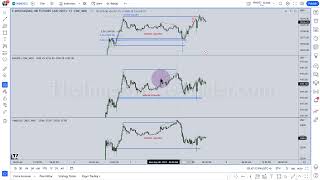
This is the Dow in relationship to the NASDAQ. Notice that the Dow was able to make a higher high, whereas the NASDAQ was unwilling to make a higher high. I teach that as SMT. Sick Sister is similar, but not the same as SMT. There are conditions in a trending market where the Sick Sister opportunity will anticipate a move that hasn’t transpired yet on one asset or correlated market, meaning or exceeding an old high or an old low.
Because this high here was taken out by this high on the Dow, it would be reasonable to expect, in a symmetrical market, that the NASDAQ itself would also go up and hit that level. But look closer—what do you see? There’s a failure here. So this high is higher than this one, whereas this high is higher, and we have a very specific time of day. We’re also looking at this divergence.
Now let’s take a look at the ES. It was able to make a higher high here as well, but it did not make the higher high there. Notice that.
So if I take this idea and show it to you on the Dow, we penetrated this high here. So you have the high broken here at AM, and then a higher high. Both this high and this high were exceeded with the Dow.
On the ES, we made a higher high here, but we did not make the higher high here at eight o’clock. So this high was lower than this one.
If we look at the NASDAQ, we had that lower high across both. This high didn’t get penetrated, and this high didn’t get penetrated, so we’re diverging. Now here’s where the Sick Sister approach occurs and how to use it in any consolidating market. If this one is weak, we’re going to wait for the weak one to drop down into a deep discount—meaning this low to this high. Let’s run a fib on it.
So from this low up to this high, here are your optimal trade entry levels, and here is equilibrium. It trades down below here and then goes into the order block, which is these consecutive down-close candles—the black ones. Then we have a fair value gap here. So there’s your discount.
If you look at this high here and this high here, that’s buy-side resting there, and I do not need it to go all the way up there to find a profitable trade. So I can be buying in this fair value gap, inside of the order block, below equilibrium, inside of optimal trade entry—these two respective levels here, 62% to 79% on the fib. So I’m looking to buy in a discount. And you can see that is the case here, right there.
Now, if I hover over Tableau, you can see I accumulated the position inside the order block, inside the FVG, inside a deep discount, aiming for the buy-side above this high here. So with that price run, I did not need it to go all the way up there, even though it was likely to do so. I got out about here because I knew that once it took out the buy-side, it could want to rejoin what had already been seen in the ES.
At these highs here, at this specific high, look how much more it dropped off on the ES and the Dow. So yes, all three dropped, but the NASDAQ did not have the ability to get back above this old high, whereas the Dow was able to. The Dow was also able to take out its high here at 2:30 from the previous trading session. ES was not willing to do so. So one of two highs was taken out on ES, both highs were taken out on the Dow, and neither high was taken out on the NASDAQ. That’s Sick Sister, and we’re in consolidation.
So that means it’s likely to drop down to a discount and then rally to go back above the buy-side, whereas the Dow was able to do so. I don’t need ES to do so, and it had already gone lower anyway.
So using the Sick Sister in a consolidation market means we’re looking for the one that failed to make a higher high or lower low, which is like typical SMT. But the Sick Sister approach or concept I’m using is that it’s going to try to do it later on, and you want to put your focus on the weakest one because, in the Bible, it says first one now, shall later be last. First one now, shall later be last.
This one couldn’t even muster enough momentum to climb higher, whereas the ES did get a little bit higher. But the NASDAQ ramped all the way back up into the buy-side here.
So in trending markets, where we’ll see opportunities like this—for instance, say this was a trending market, not consolidation—whenever I see this divergence here, and the ES and the Dow have made higher highs, but I don’t believe it’s reversing or even likely to have a meaningful retracement, I would expect this market to resume and go higher.
But because the Sick Sister approach was in consolidation, which is exactly what I mentioned this morning, and because we had converging New Week Opening Gaps—whenever you have converging New Week Opening Gaps that are very close to one another, the market is very likely to consolidate and go sideways—and when you add to that the economic calendar we had today, which was anemic and did not have any medium- or high-impact news drivers, we had a lot of factors leaning on this market being exactly what we see here: consolidation.
At two o’clock in the afternoon, it did trade back down into an order block, which is here. So at two o’clock, it rallies up and bumps the buy-side there. But notice, right above these highs, once it did that, it dropped sharply. And you have to be careful with that because it can leave that high untouched. It was this high that I was really focusing on when factoring in the Sick Sister concept and waiting for a discount. We do not simply buy here because it’s going up there.
When we’re buying, we’re trying to buy at a discount. So after it rallied up, it needed to drop down. And we see it going down into the opening session, and then you wait for that typical opening range of 30 minutes. But here, when it’s dropping down, we’re inside that 30-minute range. Because it’s trading into a deep discount, it’s inside the fair value gap, it’s inside the order block, and it’s below equilibrium.
And it did a handsome job of getting down into a cheap discount price with PD arrays that lined up with the potential long to run out the buy-side here, and then eventually here in the afternoon PM session.
Draw the parallels and the comparison to what is classically seen as my SMT. It is similar, but the approach to using the divergences in a later discount or later premium—and how you use that information—is starkly different.
Highlights
Loading post from X…
A preserved copy is ready if the original cannot load.
Loading post from X…
A preserved copy is ready if the original cannot load.
Loading post from X…
A preserved copy is ready if the original cannot load.
Loading post from X…
A preserved copy is ready if the original cannot load.
Loading post from X…
A preserved copy is ready if the original cannot load.
ict-1655622762159910927.mp4
Loading post from X…
A preserved copy is ready if the original cannot load.
Loading post from X…
A preserved copy is ready if the original cannot load.
Loading post from X…
A preserved copy is ready if the original cannot load.
Loading post from X…
A preserved copy is ready if the original cannot load.
Loading post from X…
A preserved copy is ready if the original cannot load.
Loading post from X…
A preserved copy is ready if the original cannot load.
Loading post from X…
A preserved copy is ready if the original cannot load.
Keep learning with us.
Get new ICT lessons, study notes and updates as we build V2.