
Live Tape Reading - Emini S&P AM Session - April 11, 2023
The Previous Week's Low—I was watching that yesterday. And I did not see it trade below that. I wanted to see it sweep below that and get inside of this Imbalance, and then look towards 4180. I am mai
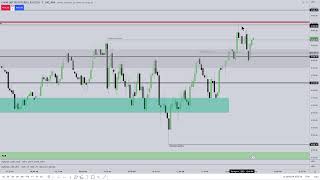
URL: https://www.youtube.com/live/VLis0LcbUaQ?si=hat8K5xfYuP4tMmy Watched Date: April 11, 2023
The Previous Week's Low—I was watching that yesterday. And I did not see it trade below that. I wanted to see it sweep below that and get inside of this Imbalance, and then look towards 4180.
I am maintaining a bullish stance on ES in here. And I am thinking that we might want to poke above this high here. And if you look real close, you will see there is a Volume Imbalance right in here.
So, in layman's terms, I am looking at this Swing High on the Weekly chart—the last down-close candle where we broke Market Structure bullish (MS+). We broke it. We had an attempt yesterday to try and get down into this gap between this candle's high here and this candle's low.
So my thinking was: if we could have traded down into that, and then been willing to go higher today, then I would take my attention to—obviously—over here, the Target High. If not that, then at the very minimum, Last Week's High.
I don't see anything here that would warrant a top. But the market is really fickle right now. So it has been a little bit more challenging than normal.
I am coming off of a week where I have been away from the market. Yesterday, I was trying to work off some "chart rust" and get myself more or less in sync with what price is doing right now. Usually, it takes me a couple of days to do it.
So I am not trying to be all that dogmatic about my opinions. Today, I am trying to warm up to what the market is most likely going to do and what it is doing at present.
⚡️ Tomorrow is FOMC. So, we are most likely going to have a small range day.
My expectation—and how I teach my students—is that we are not looking for a lot of excitement today. So, look for "bread and butter" type setups. Bread and butter setups are the real easy ones: get in, get your five handles, and be done.
Once you get it, stop trading. Move to the sidelines and go do something else. Do not try to marry the idea that you have to be in front of charts all day long. This is because of more impactful news events that are going to be later in the week, on Wednesday and Thursday.
So, all of this in here was a 4-hour Imbalance, if I'm not mistaken. Yeah. So I use the Order Block here. That is what that red level is. Trade up into this SIBI [Sellside Imbalance Buyside Inefficiency].
Okay, so this imbalance between this candle's low and this candle's high—that is the SIBI.
What makes this difficult is that we are inside of this range. And we are inside of a larger range on the Daily chart. So we are in the last several days of a trading range. So it makes it very difficult to predict, to settle on one side of the marketplace.
Everything is mixed. NASDAQ really took a hammering so far this morning. S&P has been relatively strong. But Dow has been the leader on the upside. So it is a mixed bag. And while I am expecting weakness in the Dollar, that means—obviously—Risk On for Forex.
I have to take all this information and kind of build an idea around all that. So it is a little too early, in my opinion. But I want to focus on the 10:00 to 11:00 setup.
So for your notes, they are here to try to build some understanding here. When in doubt—like, say I go into the marketplace early on, and I have been watching the market since about 5:30 this morning—I don't really have a feeling for what it wants to do, obviously looking at the chart.
One could say, "Well, we look at these lows here. And why wouldn't you want to take those out?"
They can. I just don't see that happening right now. It would be more likely to do that tomorrow, if it is going to go down at all. I don't subscribe to the idea that we are going lower at the moment. I would rather lean on the expectation that what has been put in motion on the Weekly chart is likely to continue. That means the levels I was looking for are still a little bit higher than where we are now.
And one of the ideas that leans heavily on my analysis is that we have had a movement here, and we are consolidating. Usually—not always—but usually, when there is a consolidation after a price run like this, it generally will, at the very minimum, take out the Old High.
Even if I am wrong about the continuation likely going higher longer term, this high still can be taken out. Which creates what? A scenario for a Breaker to form.
Either way—if it continues higher or if it runs this high to create a reversal pattern—it matters not to me. Because there is more likelihood for upside. It is not a guarantee—obviously, nothing is guaranteed—but I am siding with that initially after being away from the market for 10 days. I am trying to go into it slowly.
Right now, I am a little rusty, and I don't know the Rhythm of the Market right now. So I am looking for things that kind of build my confidence.
Because I can see a lot of things on both sides right now; I can argue both sides of the market. And I teach that the way I define High Probability is this: where there is no way to use what I teach to frame the other side of the trade. If you cannot do that [argue the other side], then yes, it is high probability.
If there is a 50/50 likelihood—that you can explain the market to likely go higher or lower right when you are trying to push the button—this is probably going to save a lot of you a lot of money and a lot of heartache: simply go into every trade with the expectation of, "Can I see the other side of the trade panning out?" If you can, you probably are not in a high probability trade.
So the whole premise of me being here with you and teaching is for you to identify those conditions—ferreting out, filtering if you will, the opportunities that are not so ideal.
It is a hard thing to understand for new traders. They think that because there is a lot of time, because the markets are trading 24 hours most of the time (except for the break between 5:00 and 6:00 for indices), therefore, you should always be able to find a trade. That is not good advice.
There is always something you can get yourself into. Just like the highways—I mean, you can always run yourself in front of a moving car, you can always stand in front of a falling tree. Those types of "opportunities" exist. That doesn't mean it is something that is favorable for you, or that the outcome would be favorable.
So I try to do my best. I do this by presenting you the things that I lean on in terms of experience—the things I look for to help prevent me from going into the marketplace when I shouldn't.
And hopefully, my students can glean that insight by seeing multiple examples and find their model.
Let's take a look at the 4-hour chart here.
We did not take out the low yesterday. I wanted to see it go down, clean that up, and then work towards going higher. Because I would have felt very confident—I would have been very confident this morning; I probably would have been up in London trading it long.
That is how I would have handled today. But it didn't do it yesterday.
This imbalance from this high and this candle's low—I don't need to annotate that because I have already had something that is more refined in the lower timeframe. So we will drop down into that now.
But I want you to take notice of how we trade up into the Order Block here. Large up-close candle, the shift lower. All this is a SIBI [Sellside Imbalance Buyside Inefficiency].
This down-close candle... We had Buyside here, so we ran up, hit that, and went lower.
I am looking at the Dollar Index. It is consolidating; it hasn't really moved much.
And NASDAQ—like I said—they went lower. I will cycle through when we get into the 5-minute chart through all the ES versus NASDAQ versus Dow.
‼ IMPORTANT
The holiday schedule caused them to shorten trading hours. So it kind of messes up the New Week Opening Gap (NWOG) for me, but I am adding it here because I know some of you probably have that on your chart as well.
I am not referring to that one. I am using this one here: 4140.50 and 4137.00.
The reason why I am doing that is because it is in close proximity to what the actual New Week Opening Gap is for this week—where we closed last Friday in shortened holiday hours to where we opened on Sunday. That is the little gray box area that is there just to show I am observing it. That way, you can see that it should be on your chart, as you would understand: "This is where we closed on Friday, and this is where we opened on Sunday."
I personally do not use that if we have a holiday schedule that impacts Friday. So, I will look for the closest New Week Opening Gap in the last 60 days in that range. If I don't have it, then I don't use it.
Why? The reason why is I don't trust the data. It is not based on actual market normal times. So when the market would typically close on a Friday—that is not being factored in here, even though, yes, the market did close on Friday at the time that it did. I just elect not to do that.
Because it makes me rely on another frame of reference that I would trust regardless of whether there was a holiday or not. So even if there was no holiday that impacted Friday's trading and we shortened the hours—if that didn't happen, and say it was a normal Friday—I would still have that 4140.50 and 4137.00 on my chart anyway. So it kind of removes the uncertainty that I have, unfortunately, adopted over the years where there has been impact on this particular holiday.
Therefore, I just filtered it out. Kind of like how, you know, I will use the Asian Range from a Friday—the week prior—I will use that Asian Range on Monday's trading.
Which makes no sense to anyone else. Ask anybody about the Asian Range and how that might be useful, and they will look at you and say, "That's nonsense." But that is somebody that hasn't really spent any time working with the information.
So I don't trust the Sunday session for those, either. In Forex, I don't look at the Asian Range on Sundays. For Monday's trading, I use Friday's.
And that might not be helpful to you; you may not make any decisions based on that insight. But that is what I do. That is how I look at it. Because the market is going to refer back to an actual full trading day, versus where we just opened up.
I have other tools that I would utilize for Sunday. I don't trade them anymore. But when I was trading Sundays, I would just use what you have been learning here: the New Week Opening Gap. But that is different for Forex, because Indices open with the Opening Session or New York at 9:30. So that is an impactful time.
None of the Fair Value Gaps lined up with the actual high and low. The reason why is: I see it as you will see it. But this is how I keep my chart from having a thousand different things all over it, because I want to keep it clean.
Drop down into the 5-minute chart here.
You can see now how nice and clean that is. See, we have this candle's low, this candle's high, and that little imbalance here.
That is the refined one from the 4-hour, the 60-minute chart, the 15-minute chart... refined right down into the 5-minute chart, which is fine. I don't have to worry about having the actual highest high and lowest low for that larger range, because I want to take myself into the core of what it is really going to reach for—to rebalance to.
We had a little bit of a SIBI [Sellside Imbalance Buyside Inefficiency] in here. It came back up into that, traded there at the Open at 9:30, and broke lower.
The old New Week Opening Gap—again, that is that 4140.50—we hit that as resistance. Notice, it is not respecting the actual New Week Opening Gap for this week; we traded outside of it. So again, that is the reason why I am telling you I don't care for it.
‼️
👉
If it is a holiday that is impacting Friday or Sunday—let's say there is a Sunday/Monday influence, or something causes the market to not be a full trading session—I am going to go to the Tuesday, and I will use that as my opening.
Here is how I handle the opening: I will use the opening at Midnight for Forex, or I will use the opening price at the opening—about 09:30—in the morning session.
So there are a lot of rules, and I will have all that new throughout this year, providing more of it for you. But it is better for me to teach it to you in context, when I am using it.
And you will see and you will hear at the time—like, I don't do these things every single week. If there is an impact, like a holiday... how many times do we have a holiday? There aren't that many. But you have to have a protocol to work within, to kind of filter out why you are going to use a specific tool, or when you are not going to use a specific tool.
And while I have a lot of tools, and a lot of things that make it sound and seem extremely complicated, it is not complicated when you understand the rules and when I reach for certain things.
Nasdaq is the weakest
Dow is the strongest
We had this run up here to the New Week Opening Gap—not the present New Week Opening Gap, but an old New Week Opening Gap. We hit that as resistance.
‼️ IMPORTANT ‼️
👉
And then where did the body stop? Below the Volume Imbalance. This candle here... we opened, we rallied up again.
So we crossed over this Volume Imbalance two other times. But there is no body laid across this.
So as long as there is no body laid across it, this will always act like a magnet. Okay? So, a secret for you from my Volume Imbalance concept.
So I am watching that there. We go up here to lay down a body across this range.
For me to be satisfied with this Volume Imbalance, I want to see it lay the body of a candle across it and close. Now, I don't care where it closes. But it needs to lay a body completely overtop of the high and the low that makes that Volume Imbalance.
See how we wicked right up into here and the reaction off of that? It is sensitive to it. But I want to see it lay a body across that range—that little orange shaded area.
Once it does that, and then it leaves it, then I am satisfied. And I am probably not going to refer back to that Volume Imbalance anymore. But as long as they don't drop a body across that range, you will always find a way to go back and test it again, multiple times.
So that is why I teach that, out of all my PD Arrays that are influential to my analysis, the Volume Imbalance is the most flexible one. It is frustrating for a new student to learn that because they don't know what to do with it.
It is a point where I expect price to come back to. You can come back to it multiple times. When I am done with it is when it lays a body across it, and then we move away from it. Then I will no longer keep it on my chart.
But as long as it stays open and there has been no body laid across it... It doesn't need to have both directions. Okay? It is not like a rebalancing necessity there. It just wants to lay a body across it, step in, create another candle... like, see? It has yet to lay a body overtop of it. It keeps working through it, but I want to see it trade and drop a candle body across it. And where it closes in relationship to that little orange shaded area? It is not important to me.
But you are here to learn. So I am giving the details as to what I do with that. And that is new insight.
If I were a betting man, that Sellside looks really, really juicy. Not that I think it is going to be a crashing down day. But it looks as if we want to maybe clean this up a little bit.
What changes that? We would have to get above the New Week Opening Gap high here at 4140.50.
So as long as we remain below that, I would expect price to gravitate towards that 4132.75 level.
If I were a betting man, that Sellside looks really, really juicy. Not that I think it is going to be a crashing down day. But it looks as if we want to maybe clean this up a little bit.
What changes that? We would have to get above the New Week Opening Gap high here at 4140.50.
So as long as we remain below that, I would expect price to gravitate towards that 4132.75 level.
👉
Wherever I see the Volume Imbalance form, whatever highest timeframe I see it in—that is the one I am referring to. Like, that is the parent, and anything below that would be subordinate.
But like an unruly child—you know, this is the Volume Imbalance... but look, even on the 1-minute chart, it can stray outside the boundaries. But ultimately, it still respects the order of the parent from the higher timeframe.
The bodies don't even respect the "root"... they respect it in this regard, but they don't lay overtop of it.
So all of my PD Arrays have specific characteristics.
So we did trade back up to the low—the Old New Week Opening Gap inside the SIBI [Sellside Imbalance Buyside Inefficiency].
So it should have no difficulty getting into the Sellside now.
I'd like to see it swept, rejected, and then try to move higher. That is what I would rather see here.
So that is not like we are looking for a short. Because I told you: it is not anymore taken, because there is not enough of a range.
I teach that a very Low Hanging Fruit—a very easy objective to strive for as a new student learning what I am teaching you—is to aim for 5 Handles.
That is not to say that you would stop at 5 handles, and that is going to be the most you can ever do. But for someone that has never done this consistently, and is looking for a way to be in here looking for patterns that repeat—things that build a model that repeats, looking for characteristics in Price Delivery that repeat...
The very small threshold objective of 5 Handles is something I believe in. And I think when my students go through the process of the things I am putting you through, as teaching that 5 handles—once you start getting good at finding it, it builds a lot of confidence.
And you will be able to navigate that fear and anxiety about missing things. You won't be afraid of missing moves, because there are a lot of opportunities for 5 handles to appear over the course of, you know, a full trading day.
And you can trade sometimes even outside the opportune times that I teach. So that being like the Kill Zones that I teach, that are good for the Morning Session and the Afternoon Session.
You can, if you know what you are doing, trade the Lunch Hour. But you have to understand the rules that go along with that. Because if you don't understand that, you can get yourself involved in trouble. You can marry the idea that you think you are seeing a specific price run, when in fact, the only thing that is really occurring is a Lunchtime Run against the stops. And those individuals have been profitable for the morning session, and they knock them out. And generally, sometimes the market will continue.
Okay, so let me take your attention back up into the Fair Value Gap I was talking about. And again, please don't read into this... I'm not saying "Look how smart we are," or anything like that.
What we are observing is: in a Small Range Day, how there are fluctuations that we can see, and we can forecast them. But is there really a trade there that is viable?
And what constitutes a reason for me to get into a trade? It has, in my opinion, it has to offer 10 Handles.
If the framework for the trade offers 10 Handles, then you as a student—because the reason why I am teaching you that is it will give you a little bit of wiggle room. Okay? A little bit of cushion for you to not get the best entry and not get the best exit. So it allows... it is very forgiving.
So as a Mentor, I am trying to teach you how to read where the probabilities are, the time when these patterns form, and how you can align yourself with Algorithmic Price Delivery. But if you can't frame the trade and see it moving potentially 10 Handles, and you don't know what you are doing—because you are new—chances are it is better for you to just observe. Don't press an entry on your demo account. Don't do that. Just observe it and probably be thankful that you didn't do it.
The idea is: you want to be able to capture that 5 Handle run.
Because you are new. For the folks that know what they are doing, obviously, you don't need the 10 Handle filter. You want to be able to find your 5 handles wherever you can find them once you know what you are doing, and you can be a little bit more nimble.
In the beginning, it is unrealistic for any new student—whether it be mine or someone else's, learning whatever they do and teach—it is not realistic for you to think that you are going to be all that nimble: get in near a high, go short, and get out at the low. Look at that. That is unrealistic.
Students many times come to me and they have these unrealistic expectations of themselves. And they want to see themselves do Olympic-sized feats: trade exceptionally well, no losses (or next to none), and have very, very ultra-short, small stop losses and big R-multiples.
That is the flavor in the last couple of years: everybody is trying to market this idea of having really, really Small Stop Losses and big wins.
And to me, I don't think that is something that a new trader should strive for. Because number one: it is impractical. You are not going to be able to do that. And to get to that level—being consistent—it takes a long time.
And many of you don't have the patience to even do the certain drills and things that I teach that are simple. If you can't exercise discipline and self-control there, how could you reasonably expect, as a new student or new trader, to trade with a very small stop loss and have these High Multiples?
Because you don't know how to hold on to a winning trade. It is hard to hold on to even when you are new, because you see the profit. Because that is what is going to be watching instead of price. You will be watching that number fluctuate up and down and regretting. You close a trade when it was up $1,000. It goes down, it is only up $850. And it drops to $750. And then only $700. And then you close the trade, because you think it has reversed on you. And then it runs to $2,800 or whatever it is.
You are not going to have rules; you are not going to have any experience. So that is the reason why I teach to start with 5 Handles.
Not that that is going to be the end of your career in terms of the height—that is not the zenith. That is not the apex point of your proficiency. It just means that I am giving you what I believe is my opinion. And most of my students would agree that that is a good baseline to start with.
I don't think 10 Handles is for ES [as a target] because it takes a little bit more filtering out to find that. But I think that you should try to look for a price move that offers that 10 Handles in the beginning. Why? Because it is allowing you a lot of forgiveness in entering a little too early, a little too late, and getting out maybe at the most unlikely location.
So that trades into that price of the previous candle's high. You are inside that Fair Value Gap, so you are inside the SIBI [Sellside Imbalance Buyside Inefficiency].
So that is where I teach my students to try to aim for. Because you need to learn how to hold on to a trade while it is going a little bit against you in Drawdown.
That is not something you should be shying away from. It is not something you should be trying to avoid. Because you are going to have that happen. Your trades are not going to be from your entry running straight into profit—it doesn't work that way. Okay?
Sometimes—maybe a lot of times when you first start doing this—you are going to feel that. And it is going to cause you to have a lot of uncertainty and doubts. And you need to grow through all that.
It is very, very important to go through it and not try to hide it. Okay? Not try to hide from it.
Did it deliver a run into the Sellside? No.
So having a filter, looking for your setups to P&L in the context that it is likely to move 10 Handles—all I am trying to do is get five of it. All I am trying to do is get five, so it allows forgiveness.
But more importantly, this is what you need to understand. By having this filter, it removes the likelihood of you doing a trade that is not likely to pan out. If your targets don't even offer the money—the opportunity—to get the 10 Handles...
Not that you are going to get the full 10 Handles. But if you can't offer the 10 in the framework of the trade, you shouldn’t even consider taking on the risk.
So by having the 10 Handle Filter, if you would have taken this trade here, and didn't take anything below that low here as a partial, it is running against you now. Either it has stopped you out, or most likely will stop you out.
So you have to have these protocols in place. Not because you want to paint yourself into a small box where you can't do much. But you have to have rules.
And that is what makes this business very difficult. Because a lot of people don't like to be told what to do. And a lot of people don't have discipline, they don't have self-control.
So that is why individuals that go into this industry without those characteristics in themselves—they will lose. And they take that loss, and they will attribute it to something else outside of them. "It's the method, it's flawed. The logic doesn't work. It's fake, it's a scam, the scammer guy taught me something that doesn't work."
And it is just them kind of trying to cope with their inability to be disciplined, their inability to have self-control.
And the rules that I present to my students are there to help you. They are there to provide framework. So that way, you grow in your understanding about what price is going to do. You have a context to operate within; you are not trying to guess.
It is... and I am guilty of being very facetious many times in the past, where I have done remarks where people have said, "There isn't a technical science to it, it's just trading."
But it really is Technical Science. And the Technical Science is, you know, the details. The devil is in the details, okay?
And unless you know what it is you are doing—when you are supposed to do it, when you are not supposed to do it—you know, it is going to open up opportunities for you to try to do something because you are bored.
My point in saying all this is: there are fluctuations that you are going to see in Price Action.
And you might be able to forecast how it is moving from one Reference Point to another.
That doesn't necessarily mean that that is something that you should be trading.
Now we have that candle laid across it now. So now I am done with the Volume Imbalance; I would not read and refer to it anymore because it is done—laid down a candle overtop of it.
Now, because we have that Body laid across it, that completes and satisfies my interest in that. So I am not interested anymore.
On this Volume Imbalance, it can be removed from my chart.
So I am not interested in it no longer.
The same logic that I use with a New Week Opening Gap—meaning that I would like to see price stay above this low or that New Week Opening Gap low.
So since we have traded where we are at now, I would like to see it—it doesn't mean I am demanding it, I am not trying to impose my will upon it—I would like to see it stay above that low (NWOG Low).
And then create an imbalance in the form of a Fair Value Gap that is a BISI [Buyside Imbalance Sellside Inefficiency].
I would like to see that form in a run prior to a run above the high we created initially before the Opening Range.
👉
We were looking for an idea that can be easily expected to pan out across all three averages: easily run higher for NASDAQ, easily run higher for ES, easily run higher in the Dow.
Because they are all doing whatever they want to do and are opposed to one another. It makes trading much more difficult because everything is decoupled.
All of this Buyside Imbalance—what is it short on? Sellside.
We had Sellside offered here one more time up here, then it left it. So what does that make this BISI [Buyside Imbalance Sellside Inefficiency]? It left it, went lower.
Once it did that here, that BISI becomes a Balanced Price Range.
That means it is going to stop like a brick wall standing in the way of Price Action. It stops dead in its tracks right there.
If you look at Price Action the way it is right here, right now. Do you—in your present understanding, the way you see price, or what you think you understand about Price Action—do you see anything in this that you would qualify?
Even with the benefit of hindsight, do you see something in here that you would feel is High Probability and you should have taken a trade on that?
I don't.
But many times when you are new, you feel like because price has moved, you feel like you should have been in. And that creates that Regret that materializes in Fear Of Missing Out (FOMO) on the next one.
When this is nothing. This is an insignificant price move. Nothing here was High Probability. Nothing in here warrants a reason for you to regret not having done something.
In fact, probably some of you have regretted pushing a button today, if you are being honest. It is completely avoidable.
Knowing what you are looking for... when both sides of the marketplace are presenting opportunities, but neither of them being High Probability. That is the definition of Low Probability.
And if you can frame both sides—long or short—you are really trying to trade in a condition that is the definition of 50/50. And you don't want to do that.
And many times—and I have watched live streamers, I have watched people share the results and go against the good advice of me trying to point you away from certain times: "Don't... Don't worry about it right now. Let's avoid this."
And they go in there and they plunk their money down, or they push their funded account, and either lose it or go into Major Drawdown. And that is avoidable.
Now, you know history. As a young man, I did those things. And I knew every single time before I pushed the button, I shouldn't do it. But I wanted to see what happens.
I found out. It is not fun. And it is always Regret.
So that was the reason why I spent most of my career trying to find opportunities where I blew accounts, where I blew large portions of money, went into major drawdown. And then it created the very conditions that everyone falls victim to: the fear, the doubts whether you are going to be able to do it or not.
And that becomes like a Fog. And you start worrying about those things versus "What are you supposed to be looking for in the chart?"
The Silver Bullet trade has yet to form. Not on this pair—I mean, I'm not on this particular market; it didn't form on this one.
And we got 90 minutes... less than 90 minutes still.
But between 10:00 and 09:00, I teach that there is usually a Fair Value Gap that forms that sets up a run into a Pool of Liquidity.
Right now, Liquidity has been extended to here.
Why not this one here? Because this was a Reactionary High.
So we had an energetic price run from there to there. And Liquidity is here.
What I have done here is I have used this as a Fulcrum Point. If we break lower, because we are in this Fair Value Gap in the form of a SIBI [Sellside Imbalance Buyside Inefficiency].
We are still inside 10:00 to 11:00. NASDAQ is the weaker one, so you can study this one here.
This being a Fulcrum Point... imagine this like a door, and this is the door hinge. The door's edge is here.
If it was to swing this way, you would reach down to that level here.
So we are taking this range from low to high. If that low is broken, the Swing Projection takes us down here. That is what that Negative One Standard Deviation is.
We have a low here. You see how we went below that and we had a run? It took up to this point here, didn't take out that high.
If this drops, you want to see this low get completely smoked. Not just trade a low, lower low and a little bit, and then come back off of that. You don't want to see that for price that already had a Stop Run like it does here.
I don't teach—and I don't think it is something to build a framework on—where you have a low taken here, and then one more time take that low. Because then we are talking about something like a Wolfe Wave or something like that, or broadening. Like a Megaphone Pattern, which is, again, that is like Retail stuff.
I am comfortable being wrong. You are not using that when it does form. But it is so infrequent, I could care less.
So what I have done over the years is look for opportunities where I expect price to behave a specific way. We have already taken Sellside with this low here, with that price run there.
So if this does go lower, it should do so and not respect this low at all. Otherwise, we are creating a low, lower low, higher low, and then want to retrace back up into here. We are altogether completely run out the highs here because this is the Relatively Stronger of the three averages: the NASDAQ, the ES, and the Dow here.
I don't trade the Dow; I don't ever mess with this one. Because it behaves like a brat—you know, an unruly child. It does what it wants to do many times, and it just doesn't cleanly deliver price like I like the ES to do. And sometimes the NASDAQ doesn't perform like I'd like to see either, which is again why I teach predominantly through the ES.
m5 IFVG
If you ever watched me doing the executions and I am recording myself entering and managing the trade, sometimes you will see me say in text—and I will type it out in annotations on the chart—"I'm looking for Speed and Distance."
Meaning that I want to see a specific level be railroaded through. Like this: completely disrespected. 100% is run right through it like it wasn't even there.
Whereas if this low hadn't been traded to... with this low, lower... I would expect it to do something like this always, where it is a Turtle Soup type pattern. Where it is a false break below, and then a reaction like that.
I would not expect this low, if it trades below it, to perform like this. I would expect it to give way immediately and allow a run into this area here. And if not, altogether below here.
Because we have already seen what? A run on Sellside. We have already had that.
So it is not most likely to go down below that low just to make a lower low and then rip higher. I don't like to trade that way; I don't see price like that at all.
So I internalize price being delivered: If it goes below this low—and understand that it may not even get back down here—that is problematic.
Because we want all three averages—the Dow, the NASDAQ, and the ES—to agree. That simple Dow Theory. That is Market Breadth.
That way, we can expect the continuation of a specific price run higher or lower—a continuation of Risk On / Risk Off.
We want to see market environments that are very easy to see those signatures in price. We are not getting that today, are we? The Dow is doing what we are seeing here. But we have already had a run below a low right here. So we already had Sellside taken.
So there is really no need for this drop here to go below that low unless it is really wanting to go lower. Because we have already done the work of going down and stopping traders out that were long. We have already done that here.
So how do you use that information with the ES and the NASDAQ? That means that you are probably best suited taking profits in the event that your target or targets may not be filled—they may not be reached.
So the point what I am trying to make is: we have already had this run on stops. So if this low is taken out, that would have accelerated the down move in ES and the NASDAQ.
But because we have already had this run on Sell Stops on the Dow, we have to be leery of this low being taken. Because we have already seen Sellside Liquidity taken out.
So anyone that is long here, they had their stop loss trailed here. A drop down cleared their stop. They are no longer long. Then it rallied. Did it take out the high? No.
But this drop down here has to allow for... at least in my mind, this is how I teach my students to weigh out the relationships of Intermarket Relationships in the three indices.
I don't care about the Russell. You know, I don't care about that as an average. We are just primarily about the Price Action in ES, Dow, and NASDAQ.
And even though I don't like this particular index—because it is a brat, it doesn't behave like it should a lot of times... sometimes it will. But most of the times, it just does whatever it wants to do.
And because of that, even though it has Volatility—that volatility is notable, you can see it in the chart—but it doesn't mean anything to me as a trader that says, "I'm going to jump on that."
But the insight I just gave you in relationship to that low... That is information I do derive from using the Dow.
But it doesn't need to be the Dow that had performed this very thing. Let's just say that this was the NASDAQ. And the NASDAQ had that low and it went lower low here. And then we were dropping down... I would expect and demand that that low be taken out aggressively with Speed and Distance. Meaning it should go right through it.
Partials pay every single time. 100% of the time.
100% of the time, a Partial Profit always makes money. There is never—there has never been an instance—where you as a trader, or me, or anyone else that takes a partial profit, where it did not pay you.
It always works. That always works. It is 100% accuracy and profitability when you take something off in profit.
That is the whole reason why you are doing this. You are not trading to get the best exit, the best entry every single time. Because that is unobtainable. You can't do that. You can't. No one can do that, okay?
There is something... there is always going to be a drag on your performance. Whether it be your health, your focus, the markets being... well, in my opinion, they are very fickle. Right now, these are very challenging market conditions.
I like a Fast and Loose Market. It doesn't mean trending; it means that it has to have a lot of Symmetry to it. But also, these need to be moving in a level where I can predetermine them with a great deal of ease.
If I don't have that, then I have to either decide to do nothing, or just simply observe—Tape Read.
But my point was: when we are seeing it trade down here, I may not get my objective, which is what I showed you here. It may not reach that.
I am showing you the logic right now, using the Dow. How I would use that information because the Dow had already went down and took out its Sellside.
So I would demand that the Dow would have careened right on through that old low.
And because it hadn't done so... And ES is expanding lower, even though it is getting real close to my objective, but fails to reach it and retraces higher.
When I am expecting certain things to unfold, like I want to be in a trade that is a Low Resistance Liquidity Run. Where it is easy, it just runs away from my objectives. And it is just like a hot knife through butter.
And my tools and my teachings teach you how to find those conditions. But those conditions don't exist every single day. And that is the problem with new traders coming to me. They think because of what I am teaching, therefore it should be every single day. Because they take my mottos—"Every Week, Every Day"—and it won't stop. The logic of what I teach is there every day.
But your specific Model—now listen, this is important—your specific model, the thing that you look for, the framework that gives you the trade idea, the entry mechanism, the multiplier that you use to get into that trade... may not be there that session, that day, on that particular asset.
But it will exist somewhere else in another asset. And that is the problem. That is the problem because that invites the thing I teach you not to do, which is have 28 different markets, and you try to scatter your attention. You can't do that.
You would be better rewarded by limiting your focus to one or two at most closely correlated markets like NASDAQ and ES. Or, if you are trading Forex, British Pound and Euro Dollar. Which is exactly how I taught for years when I was predominantly teaching Forex: using the Dollar Index as an intermarket relationship that would be inversely related to what the performance of Cable and Euro would do.
So right away, you can see everything on this outline. All that was a reason and justification for this type of move here.
So for the people that say, "Don't take Partials"... Great. You just got stopped out. Well done. You got nothing. For the time you invested, you got nothing.
Who is the greater fool? Someone that uses logic that yields Partials—if for nothing more, still, again, still a profit? Versus the guy that wants to teach: "Your Stop Loss is your exit. And your Target is your only profit."
Like, that is really, really placing a lot of demand on your performance when you don't have that experience in the beginning. How could you reasonably expect to have the wherewithal to get into a trade where you know that you got a solid entry, you know your Stop Loss is unlikely to get hit, and you know for certainty—don't think about this, that is what is being promoted in this logic: "Don't take partials"—you are stating that in your infancy as a developing student and trader, you know absolutely 100% that your target is getting hit? So accept nothing less?
That, my friends, is too myopic. That is someone that is posing as an educator but has really no idea what they are talking about.
You can't take someone that is new—a greenhorn right off the streets, never done this before—and tell them: "Hold for your full target or get stopped out and learn from it."
You know what you are going to learn? You are going to learn that you probably don't have the discipline or patience to stay at this long enough to find profitability in that approach.
Whereas I teach: If it gives you something to take off, take it.
That little reward, many times, is the thing that carries you through the times that everybody goes through when they are learning how to do this.
And Price Action is like this. This stuff right here? This is the stuff that breaks the backs of new students. They don't want to stay in this. They think there is something else better. They are going to chase something else. Because somebody else out there did something with really no logic behind it, and they want to champion that result on social media.
And they think, "Well, have they got something?" And you go chase them. And then they go into a tailspin. They can't find the big moves or they can't find a real nice move, and somebody else is producing that. They look at it, "Oh, let me jump over there and do that."
Versus sticking to a logic that works well in the right market conditions.
Think. You are here to learn how to read Price Action and control your emotions and your actions. You have to have a reason to be pushing a button. But I am showing you in these live streams that there are times when you don't want to push the button. You don't want to do it. Because the logic behind having pushed it would be basically the equivalent to Gambling.
So we're all over the place.
What I said earlier about this low here: We already cleared out Sellside.
So the only reason to come back down below that low is to completely wipe out all the movement higher on the Dow, and that would accelerate the lower moves on ES and NASDAQ.
All this run looking at... here is your Imbalance. So in a Symmetrical Perfect Market Condition, the market should have went right to that there and then rolled over. None of this should happen.
But what is resting above these highs? What is above these highs here? What kind of stops? And who is using that stop? Shorts.
So how do they protect the short position? Buy Stop. So all this run up here is setting the stage for a run of those. Which is problematic for ES moving lower.
So we didn't get down to that Imbalance identified; it could have reached for it. We did go lower. We traded below the Sellside here. But that was very, very short-lived.
And what was the warning sign? What I showed you in the Dow real-time, explaining it to you why it is likely to be a factor in seeing the sustained price run lower on ES, even though the target was identified.
How do you know when a target is not going to get there? Michael, these are lessons I can't write in a paragraph. I can't write a book and have chapters that talk about that. You have to see me doing it like this. Because then it makes you remember this.
Now, because you saw it, you are going to know: "Okay, if I am in a price run, and I am going to trade... How are the other averages?"
If I am trading—or you are trading—stock indices... let's say it that way. How do you trust that the trade is likely to continue? Well, the things I am telling you to look for.
But if you have these big road bulletin boards, like we saw in the Dow, saying: "Okay, we are having difficulty here, expecting it to go lower, because the Dow already ran its Sellside."
So if it is not likely to take that low out, then you probably should be Taking Partials. As it is careening into your target, just take a partial because you might not get that target filled.
And when you do get stopped out on your balance, guess how it feels?
"I made money. You didn't beat me."
That is what I think in my head all the time, every single time I do that. "You didn't beat me. You stopped me from getting all of what I was trying to get. But I still took something off your rear end."
That is how I look at it. So I don't look at it as Chess; I look at it as Gladiators.
Okay? I am stepping out there, I am putting my expectation in the marketplace. And I am in there warring—like you are expecting to take a Pound of Flesh. And I might not get a full pound. I may get a quarter pound, I might get a half a pound. But they didn't take anything off of me.
And I don't feel any regret when the market trades against me and stops out my remaining balance. Because as soon as you take a partial, then you reduce the stop.
You do not reduce your stop to Breakeven or better until you take a partial.
That is a very hard thing to grow accustomed to as a new trader, because you are thinking, "I gotta get to breakeven, I gotta get to protect myself, I don't want to take a losing trade."
You need to stop worrying about that. And the easiest way to get over that is learning what I am teaching you: to avoid the conditions like we are seeing here, where it is iffy. It is really hard for price to have sustained price runs to reach into your targets without having these choppy retracements. It is frustrating.
So that is why I teach in a mentorship capacity. Most of these lessons are to keep your mindset focused on: "Yeah, you can observe Price Action in these types of conditions. Yes, you can expect some type of fluctuations and see it panning out to a certain degree."
But not like in Low Resistance Liquidity Runs, where the market simply lays it in your hands and asks you if you want more.
Whereas this one... when it is like this... this is High Resistance. High Resistance Liquidity Runs. Yeah, you get movement. Yeah, you can probably see this in that panning out. But you are not getting the full runs. And everything is disjointed.
Whereas, you know, a Symmetrical Market—and this is what you should be writing down in your Journal, by the way:
A Symmetrical Market is where the Dollar is going higher, and the NASDAQ, the Dow, and the ES are moving lower. And they are not having much of any kind of consolidation or retracement when the price runs begin.
That is a Symmetrical Market. You have a Risk Off scenario: Dollar higher, all indices moving in the same direction. And they are all moving very nicely. And all Price Inefficiencies are being respected.
Whereas here, we have a lot of give and take. It is back and forth. I don't like these types of conditions.
Can I find 5 Handles on that? Yes. But I know I can. Whatever I could do in an environment like this, I can do 10 times more if I just wait to the next day, or the day after that.
That is Maturity. That is Experience.
You as a new student don't have that. So you think that the only trade that is ever going to matter is the one you are about to take right now. And your entire career rests upon the outcome of this next trade.
It sounds silly, but if you really think about it, that is exactly what you are doing. I know it, because I did that too. And that was because I didn't know how to trade. I didn't know how to read price. I didn't know the consistency on how these things form multiple times over the course of a week.
And when you have this understanding, and you have this experience, you don't feel like a victim of your own emotions. Where you feel like, "I gotta do something, I gotta push a button, I gotta do something."
No, you don't. Who says you have to do anything?
I am saying you have to learn how to Read Price. And you have to form Discipline and build Self-Control. Those are skill sets that happen by doing what we are doing here: not one button was pushed. No entry. Nothing.
I am thankful that I have done nothing today. I am appreciative of the fact that I am aware still that these are conditions that are going to be problematic for me.
They may not be problematic for you. You might have some kind of new widget indicator, something that you are following, and it is producing you some kind of mechanism that tells you to buy or sell. And it gives you some type of result; at the end, it tells you to get out of it, and you made money. Well done.
Just read what Price is trying to do. It is only doing one of two things, okay? It is going to go higher, or it is going to go lower.
If it is not going to consolidate, we don't want to do any Consolidation trading. But if it is not consolidating—and take that out of the equation—it is only doing one of two things: go higher or go lower.
And it is only going to go higher for one of two things:
- It is going to go up for Buyside.
- Or it is going to go up to a Premium Imbalance that it is going to reprice to.
If it is going to go lower, it is going to go:
- Down below an old low or lows for Sellside.
- Or it is going to go down into some Discount Inefficiency.
It is a Fair Value Gap... I get it. That is easy, folks.
But what is hard is knowing the Climate that you are looking at right now. How to determine if the market is really likely to pan out and have a really nice run for you.
That is a skill set that is not taught by anybody else.
You need to have Patience.
And if I go in there and start teaching you buying and selling Entry Points, all I am going to do is ensure that you fail faster, without understanding why you should take that buy or sell in the first place.
Think about it for a second. What matters more: your Entry Point or where the market is going?
Because if you know where it is going, and you are using a framework that allows for enough of a range...
Remember, I was telling you earlier in the presentation that I teach my students to focus on a 10 Handle Run as the framework for the trade, even if you are only trying to get 5 Handles.
Because it allows a lot of forgiveness for you in your infancy as a trader. And you don't know what you don't know right now.
Like, you don't realize the Vacuum of Insight that you need, that you want to have Consistency with. But you haven't adopted the things that resulted in that outcome.
You are trying to avoid the things that are necessary for you to engage yourself with, which is getting in in tough market conditions.
Because these conditions here are going to teach you a lot about who you are and what things are going to be problematic in your trading: Impatience, Imposing your Will. Forcing something that isn't there, Chasing Price once it starts moving.
If you do those things in this type of market environment, you are going to lose. You are going to blow your account, you are going to lose your funded account, you are going to be very frustrated.
I don't put you in front of the charts when it is like this just to torture you. I am teaching you this is what you are trying to avoid.
In the times that are not presenting the market conditions like this, you will see it is a lot easier. And you do most of your work there. But you exercise Patience and Discipline in these market environments.
You tell yourself: "I am not expecting a big explosive type of market move here."
And you watch what price does. And you put yourself in a situation that:
- If you were Short, how would you feel about your short?
- If you were Long, how would you feel about your long?
- What would you want to see happen?
And you go through that Internal Dialogue while you are watching price. You are not trying to be right about anything. But the experience that you get watching price paint like this without any monetary connection—whether it be demo trade, or paper trade, or a funded account, or a Live account.
All you are trying to do is determine what your mind—what your Psychology—about what you are seeing in Price Action is telling you as the person, not the trader. Because you are not the trader yet; you are just learning.
But what are you focusing on? Do you feel... well, do you feel like you missed something? That is Impatience.
Do you feel like you should get in here right now and push a demo? Well, that is Impulsiveness.
They are going to manifest themselves in your real trading. And unless you learn Coping Mechanisms to overcome that and replace it with real positive things that counteract those: Impulsiveness, Impatience, Gambling, Chasing Price.
Okay? Fear of Missing a Move... getting in after it got ran eight handles. "Yeah, see, if you're a guy, it could go down. But what if it doesn't? Let me just buy it now." And then it goes down to Fair Value.
All those things, you need to know what you are going to feel internally. You may not have any things I just mentioned. But chances are you probably had at least two and need to recognize that before you put money at risk.
People want to get here and just start making money. And you can't consistently do that if you don't discover who you are and how you are going to derail yourself.
And the only way you can determine that is not by reading a book written by me in the future or anyone else's, or buying a course, or using an indicator-based strategy that they create or authored, or newsletters, or market weather.
All those things are going to keep you distracted from finding where your problems are, because they are always Internal.
Every single losing trade has one common denominator: It's Them. They did it. They pushed themselves in the trade. They put themselves in a trade that they knew, if they were honest, that it was probably not going to work. It is not going to work.
But you just don't have the courage, discipline, and self-control to stop, turn the charts off, and come back another time when it is more likely to pan out in your favor.
So you don't have that. So you are thinking: "I sat in front of these charts? I put all this time into it. And what do I have to show for it? We didn't do anything. We didn't push the button. I've done nothing."
But you have learned how to do what? Manage a Trade Idea.
If we are looking for lower prices, how do we know that it is not likely to continue before it reverses on you? That is what I outlined today.
The last livestream I did, I picked a condition. I said, "You know, here is a... here is a Low Probability condition." So I warned you ahead of time telling you this is something I would not take a trade on, but we are going to force an idea on it. Okay? We are going to push it into the marketplace.
And we are going to say this is a Fair Value Gap. And we are going to say that this was where we would go short. Just watch the last video, you will hear and see it.
And then it would have resulted in a trade that didn't really pan out. But we learned real time. How we say, "Okay, this is not what it should be doing." It traded outside the lines and the boundaries.
So we could Collapse the Trade and have a very small loss.
Just like I teach in Partials with profits, I teach—and taught in that livestream real time—where you can take your Stop Loss and reduce it. Without moving it... it is, "Okay, I am not willing to take a full stop out."
We are in that trade. I would have taken a full stop. And even talked about when I was a 20-year-old, where I would wrestle with the idea instead of saying: "I am wrong." And either close the trade, take partials off—not in profit, but take partials in terms of the position size and reduce it—which would otherwise be a reduction in Exposed Risk.
I didn't want to do that as a 20-year-old. So I would move my stop or remove it entirely. And if I would have done that in that livestream, you can see the effects of that. And that is what I was doing to myself as a 20-year-old.
But you heard me explain how that is not what you saw. And you didn't see that in price. So therefore, you would collapse the trade here and then move over to NASDAQ. And it is okay, here is a buy... and showed you how it went up and that would have covered and mitigated that loss.
When you go back to the original chart or market that you are following, which was ES, and then we went to go up and pan out, like gangbusters.
Those are the lessons you can't learn from a book.
We had Buyside in our crosshairs on that one. Then here we go. Rather than Equal Highs.
I told you what would be above that buyside. What was the warning sign? We already seen Sell Stops taken on this pass below that low. So this is just a Retracement lower.
But it was helpful in the regards of how we would manage our ES or NASDAQ trade: take Partials.
How much... how much of a partial do you think you would have taken?
Given the context I was outlining real time with this low, in relationship that we have already seen these stops... you would take 50%.
You don't take your lowest partial off; you take a large portion off.
Because you have warning signs that it is not likely to do what? It is not likely to go lower.
But if it does, that's great. You have the remaining portion of your position still on. In the short run ES or short on the NASDAQ.
You have no idea the impact that studying without pushing a button is going to have on you until you start doing it.
It is not wasting time; you are investing in yourself. And you are rewarding yourself with experience that you can't get any other way.
You can't. There is no other way to obtain this, except for being in front of charts and studying in real time. And measuring how you—each one of you listening to me—are going to bring to this endeavor your own problems.
But you don't want to see them as problems until they manifest in your charts. You are trading your perspective and how you react to what price is doing.
Are you mad about what has happened today? Are you angry that it didn't do a specific thing?
That is showing you something about yourself. And books don't do a sufficient job of:
- Dealing with identifying that.
- How do you correct it?
Because that is exactly what is going to undo you. That is the thing that is going to be in your way.
It is not the fact that these concepts don't work—because they do. It is not because the logic is flawed—because it isn't flawed.
It is what you are doing with the information. What are you doing with this information?
Are you abusing it and using it outside of the rules and context that was presented to you? 99% of the time, if any of my students have that [failure], that is exactly what they have done.
Or they listen to somebody else that has "Dollar Menu Mentorships." And they want to do everything on a five-minute timer basis. And you can't condense this.
These are the things that you have to go through. And this is exactly what I was putting my mentorship students through who paid me. They had to sit here and watch me jawbone about the Price Action.
And because there was no button being pushed, the weak-minded individuals would quit.
The ones that endured it? They are the ones you are seeing now being interviewed. They went through all of this. And they did it when I wasn't doing it too. They took it serious. They treated it like a Business and an Investment in themselves.
And if you don't have those characteristics in yourself, you have to develop them. Otherwise, you will be removed.
This business has an efficient way of Taking Out the Trash.
If you come in here with the Trash Mentality—that it is going to be easy for you, and it is owed to you to be fast and quick—you are going to be treated like trash. You are going to be taken out in the bin.
And there is nothing you can do about it until you change how you think.
I had to endure that too. I didn't like it. It wasn't pleasurable. It wasn't fun. I tried to hide it. I tried to pretend it wasn't really there. I tried to blame everything I was learning.
And it was Me.
And then when I corrected those things and replaced them with being Diligent, Organized, placing Limitations on what I am expecting to see in Price Action—"What do I want to see? What shouldn't take place?"—and then spending time identifying the things that repeated that caused or negated those conditions being impressed.
These are the things that I hurt myself with not knowing these things. Not knowing these things and allowing a very small little disruption—an idea that I was trying to make happen in the charts.
And I wouldn't let go of it. I wouldn't feel comfortable changing directions.
But I had to learn that skill. I had to learn to let go of an idea that I may have started the day with.
How many times have you fallen victim to that?
You do your Analysis. You have the expectation that the market is going to do a specific thing. But then it doesn't. And then you get stopped out.
And you force it. "Oh, it's going to do it now." Because You are Right.
And then you take another trade, and you lose.
But no. No amount of Drawdown on those two trades is going to deter you from taking that third trade. Because You are Right.
And you take the third trade. And either Blow your Account, or put yourself in Severe Drawdown.
How many times have you done that?
I am teaching you how to avoid that. That one moment isn't limited to the Drawdown or the Blown Account; you now have Scar Tissue.
And it is going to impact every trade that you take the rest of your career.
And you want to minimize Scar Tissue in the beginning, which is the reason why I teach through Demo.
You don't have any reason to be upset. But you have all the upside in terms of understanding and learning.
You have Pain-Free Learning. Except for Pride.
And for men... for men, that hurts worse. Somebody will probably cut their pinky off before they had their Pride hurt.
If everything is moving against you—an idea that you are expecting to see unfold? And it is not really moving all that much?
Why should you be incurring Risk?
Because you are going to equate that you put time in front of the charts, so therefore: "I gotta get something out of this."
So why do you want to open the invitation for a Loss? How are you going to feel about it then?
You will never read... you will never be able to take the information that was presented to you in a situation like this, like today.
If you go and say, "Okay, I have had enough of this guy talking, I am just going to go and take a trade."
And then you take that trade and you lose.
Everything that you would have retained as Insight—useful information—you now have replaced with a Negative Experience.
As a reminder, when you are looking at the Tape Reading, like this, what this is doing is conditioning you—because you are probably very bored right now.
And that is exactly what you want your trading to be. You want your trading to be Boring.
You don't want it to be a reason for you to be hyperventilating. You don't want to feel any heart palpitations, nervousness, sweaty palms, agitated. You want to be comfortable. Not feeling like every instance that a new candle forms, or every second that ticks by, the Impending Doom is just now looming.
That is what you are doing to yourself by trying to trade with Real Money, or a Funded Account, or try to get a funded account, before you know what you are doing.
This is how you condition yourself. This is how you remove all of those things that plague every single trader out there. Everybody who has ever traded with real money has gone through all the same things. And that Psychological Warfare that you put yourself through... they are all Self-Inflicted.
And the only way you can prevent that from occurring is by Conditioning.
That means getting here, reading Price Action, without having any monetary link to a reward or profit. And getting bored with reading what price is doing.
And over time, when you can do it efficiently, consistently... and here is the most important thing: You have No Emotion.
You are not high-fiving yourself. You are not Peacocking around the house, parading around in front of your spouse, dancing around saying, "I did it again."
That is not what you are doing. You win, you say: "Okay, well, that is what I was expecting it to do. And the model worked here. Wonderful."
And when you don't have the impulse to go in again because you felt good and you want to get another one... Because if that is how you feel, you are addicted to Dopamine. And winning trades give the biggest hit of dopamine.
But it only lasts, apparently, for like three or four minutes. Because right away, you are going to feel impulsive. Like, "Oh, there is another one. Let me get into another one. I'm on... I got... I'm on a roll today."
No. Stop. Turn the charts off. And go do something else and then come back and see what it did.
And then that is a learning experience. Because if it moves more after you got out profitably, and you feel Regret...
I'll cover the Lunch Run for you. We have seen this morning price drift in a Consolidation lower.
Where is the Liquidity for those individuals that have made money going lower? Above here. And we are right here.
So the way this works in Lunchtime Trading is: the lunchtime hour going into 13:30 [1:30 PM] in New York local time.
‼️ IMPORTANT
👉
Typically—not every time. Typically, majority time, the run during the lunch hour up to 1:30 will be a run against the positions or where Stops will be placed on the bulk of what was seen in the AM Session.
Meaning: Where was the move? The move was from this high down to that low.
So where is the Algorithm going to seek to Reprice to, to introduce that liquidity to the marketplace?
It is this high and this high. So you want to annotate your chart like that.
We have two Down Close Candles here. NWOG [New Week Opening Gap] Consequent Encouragement. So it is like the Midpoint.
So we would like to see it accumulate here, because we already traded into the high of the down close candles here. That is an Order Block.
We also have Consequent Encouragement. We want to see it perform where it wants to drive up to the high of 4140.50 (NWOG High) and attack the Buyside here.
If it can get to that high, we want to see Speed and Distance to do what? Run for the orders over 4142.75.
Why would we want to see it delivered like that? Why would we want to see Speed and Distance once it trades through here?
Because anyone that has a Stop Loss here would want to do what? Collapse the trade and not let their orders be there when the market reprices to it.
So we want to see it try to gravitate up into that... and as it gets there, we want to see an Expansion reach above here.
And look what is resting right over here? We have a little bit of an Imbalance here, and Buyside resting above that.
You have a small little Fair Value Gap and Buyside resting right above that high here...
So in present market conditions—conditions in Structure—we don't want to see price trade below the low at 4137. That is the New Week Opening Gap [NWOG]. That is an old one, but nonetheless, it is still there.
We want to see... if it can go down there, we don't want to see it give up that level.
It is better for it to leave the difference between this candle's high... or here, this candle's high... and this candle's low. We want to see that range between the NWOG Low and this low of this candle... we want to see that remain open.
That would act as a Breakaway Gap.
So we are kind of forecasting not only a direction, but we are also trying to forecast a Behavior in price. So we want to see this area stay open.
If it goes down here, it just means it is not likely really to be all that Animated to the upside if it does so, because it is in more depth in that consolidation pattern.
Whereas... I expect, because we are going into the Noon Hour in about six minutes or so, it will likely trade up into the Buyside here.
If it can do so, we want to see it become Animated. Have a big range—or a couple ranges—that go up into the 4142.75 level, and then up into potentially 4145.
So we had this low taken here, this low taken here, this low taken here.
Was there any Animation to the downside? A lot of movement lower? Big ranges down? No.
So if NASDAQ is going to fall victim to the Lunch Hour—where it moves against the traders that have traded Short through the Morning Session...
Where is the Buyside on it?
This is not a Symmetrical Market; it is a Decoupling. That means everything is not in agreement.
It doesn't mean you can't trade it. I gave the logic and the Framework based on that New Week Opening Gap.
What we would expect to see... what would be Favorable.
When you are watching Price Action live like this and you are Tape Reading, you want to keep your Annotations on there... just lighten them up.
That way, your focus is on the ones that are Active still.
Now think about what I outlined. When we were trading in the 90s, trading S&P, your Daily Range was extremely small.
Like... that is this. This is what that range was like, this day here. And it would blow the socks off of you all today, because a day like this is probably nerve-wracking.
Because you want to see these big runs and big extrapolations of upside and downside, and a lot of Whipsawing around. And you are all spoiled with that level of Volatility.
When I started, the volatility was very small and contracted.
So I am not afraid of these days. I just choose to wait for what I know: that the market is likely to create a Larger Magnitude of a move. And I know what I am looking for. So I know I can be Patient and wait for it.
Where you... if you are new, and you don't know what you are looking for, and you fall victim to yourself... you get Impulsive. You don't know how to wait. You think every day is going to be a big day.
So you go in there and you Plunge, doing something you shouldn't do. But not realizing you shouldn't do it, maybe because you are too new.
We don't want to see it go down below that 4137 level.
So there is a Limit.
Okay, I want to see price go down below this low. But I do not want to see it go down to this NWOG low and lower.
It is better if it doesn't. Why did I say that?
I said that if it stays open—partial here—it would act as a Breakaway Gap.
Allowing for... even against a Higher Running Dollar.
If you don't have my New Week Opening Gap concept... if you are not interested in it, if you are not looking for it, if you don't have it on your chart, if you are not aware of it...
You won't have this Context. You will just see that Imbalance.
And you might look at this opening on this candle here, and draw it out, and think: "Okay, if it touches there, I'll buy that as an Order Block."
When in reality, what you should be seeing is: It can trade down there, but we are waiting for something to unfold that leaves a portion of this entire range open.
But framed on what basis? This New Week Opening Gap Low. And what else is existing.
We have Wick, so watch what happens.
4138. Even the low on this candle comes in at 4137.75. That means to get that book of 4138, it has got to go one tick below it. The difference between the Bid and the Ask.
The reaction off that wick... and here is your Fair Value Gap using the context of the New Week Opening Gap Low, which is this here.
Okay? We are trading down... fell short of it by one tick. Contraction of the wick here.
Leaving this portion open acts as what? Breakaway Gap. Fueling it to run to Buyside.
What is the Context?
Context is: We are in a Time of Day where the Algorithm changes its delivery. What is it going to do?
It is going to move on traders that have open positions that have made money in the morning. Where are their stops? Boom.
If there was no Algorithm, these things would not happen. They wouldn't happen. Just like I outlined it, they wouldn't perform this way.
This is the Dollar right now. So we have been seeing all of this.
So I called this move on the ES; it is not a significant price move.
But that move was what the moves were in the 90s. Like in the 80s and 90s.
That was a move... like, that was a move that you could be proud of.
You wouldn't be happy if you were trading in those Low Volatility Conditions.
👉
It is not a matter of looking for a Fair Value Gap, or an Order Block, or a Breaker.
You have to understand that there are certain Times of the Day.
Because it is Time and Price. The first important factor is Time.
And if you don't know what time it is in relationship to what the Algorithms do... the relationship between Smart Money that uses an algorithm to get in sync with the algorithm that is the Price Engine.
That mechanism that causes the markets to run higher or lower.
For Liquidity.
It is not the Buying and Selling Pressure.
It is going to go to these levels, regardless of how many people are buying it or selling it.
There are lots of people that are always tossing Market Orders in here. And all you got to do is control where it is going. Somebody is going to Book the Price.
There are always market orders coming in. Not everybody is trading with a Limit Order. Not everybody is trading with a Stop Order. Market orders are coming in all the time.
And they only need One Contract to book price.
So your idea about Volume is flawed.
You have to know what they are doing, why they are doing it, where they are taking price. And for what reason?
And When is it expected? Time.
When I am teaching you, I am teaching you how to Anticipate certain events by time.
So I am not worried about missing moves. My students are not worried about missing moves.
Why?
Because they have done the work. They have done these things.
And they have seen the evidence that these things repeat by Time first.
So we can Anticipate when the next type of setup is going to form.
You can schedule your Trade Setups like the TV Guide.
I know every single day, every single trading day that has a full trading session... so if you can schedule things like 11:50 to 12:10.
There is your Lunch Macro.
In between those two times, okay? There will be a Price Run that runs the Liquidity that goes against the Daily Range.
And what am I saying there? I am stating that the price will run to the liquidity that will be used for protection purposes on what was utilized in the delivery of the Morning Session.
In layman's terms: What has happened in the market since the morning 09:30 drop? So Shorts have been profitable.
At 11:50 to 12:10, it starts in a Macro.
Okay, a Macro is a shortlist of directions that the Algorithm itself will start operating under.
I am not form-fitting this. This is not cherry-picked. I have literally walked you through exactly what you see in your chart right now, based on the Time it is going to form.
I didn't create these times because it happened to work today. These things are in my teachings.
It runs for the Liquidity that was used for protection from the Morning Session. That is what the Lunch Algorithm does. It runs on Stops. It offers liquidity to the marketplace.
Well, I told you where the Buyside was here, and I told you it was over here.
And we want to see what? We want to see Animation. We want to see the market move with Speed and Distance.
This candle starts. It is a small little drop down... leave this portion open as a Breakaway Gap. Run up into that level there.
Now, the question is... here is the question you need to ask yourself: Can you see 10 Handles in that? No.
So for you as a new developing student, could you take that trade? No.
If you have been immersed in the things I am teaching, you have been doing it for a while, and you are a bit more nimble... Could you take that trade? Yes.
Who is going to tell you when you can do that? You and your Experience. And when you are not Emotionally Attached to the outcome.
Think, folks, think.
If there wasn't an Algorithm, this stuff couldn't be called beforehand. It wouldn't happen like this.
When I first learned how to do these setups and such, I didn't have the Confidence.
It was uncomfortable waiting for the results. To sit through it? "Will it really do it? Will it really do it?"
And I had to forge Patience.
It didn't happen overnight. It is not going to happen overnight for you.
By watching me do this, you get the splash-over... the bubbly feeling of, "Well, that did pan out."
And some of you are Regretting not having bought it.
If you feel that you are not ready...
If you watched this, you respected the idea that we watched this morning and how we transitioned to the Lunch Hour and the Macro outlined, and everything panned out like we were looking for... Wonderful.
And you are not Emotionally Attached to what took place. And you are not terribly excited, and you are not turned off by anything. You just are blessed to have been here, and you observed, and you picked up more Insight.
That is the Right Mindset.
If you are thinking to yourself: "Okay, what is the next move?"
You are Impulsive. You are going to have to fix that.
Just because the Trade Closes... the idea comes to Fruition...
It doesn't mean: "Okay, immediately go on to something else. Let's go on and do something else now."
The main takeaway is that we can Predict Price. We can do it very precisely—like scary precision—with Price Action.
And again, that wouldn't exist if the markets were all moving by Supply and Demand... Buying and Selling Pressure.
You are in the right place. You are in good hands. I am not charging you anything. I love doing this. I want to see you succeed.
I have given you more time than I allotted for today. Because I know, if I sat here long enough, I would get that 11:50 Macro.
These things are Predictable.
So if we can time a Framework that exists in the morning... let's say it doesn't materialize. Like, I didn't have a Silver Bullet setup this morning.
No problem.
Does that mean: "Go out there and just go roll the dice and do something outside of your model?" No.
You Wait. For what, Michael? What are we waiting for? What am I looking for? Time.
So if I can't find the setup I would like to see between 10:00 and 11:00—if I am choosing to trade with that Silver Bullet model...
And maybe it formed in a market that I wasn't watching?
Am I gonna get Revenge on the marketplace for doing it somewhere else and not allowing my market of choice to form? No.
I Wait.
What am I waiting for? 11:50 to 12:10.
In between that 20-minute window, there will be a Price Run that begins. It doesn't mean it completes in that 20-minute period. It just means it Begins.
That Macro starts running Algorithmically.
And it will run to Liquidity. And it is not random.
The market can be Timed. The market is running on Time.
Everything about the market is Time Based. It is Time Driven.
Everything about this day—and every day—is Predetermined.
There are times when Manual Intervention comes in. And it completely disrupts everything. And I will be wrong on that day.
As long as there is no Manual Intervention... I am going to be Right.
I say that because I am the Author of these concepts. But that does not mean or invite you to think... I want to think like in terms of right or wrong.
But I know when I am unlikely to be ran over by Manual Intervention, most times.
But I am still subject to getting railroaded by any old Black Swan Event that anybody else would be, you know... railroaded by too.
That is the Inherent Risk. Everybody has that same risk.
We don't know if they are going to drop bombs anywhere and cause all kinds of geopolitical things... upheavals. We don't know. You don't know that. I don't know that.
I am expecting things like that to occur. We are going into some really turbulent times.
But barring those events... Price is Absolutely Predictable.
I explained to you how that low down here was Problematic in reaching to the objective down here.
You can't have... you can't find a chapter in books or courses to talk about that. You have to have somebody that knows how to do it, navigate in Real Time, and explain it to you.
Then we transitioned into the Lunch Hour.
And I outlined exactly how that candle here formed... leaving that portion down here. And how we would run for the Buyside here... run for the Buyside here.
And if we got the Speed and Distance and reach—like we saw here—it would go up into that.
We know what we are doing. We know what we are looking for. We are not taken by Surprise.
We are not following Flawed Logic. We are not looking at Retail Indicators.
The only thing that is on my chart is a Reference Point that the Algorithm itself will refer to... and why the market will respond accordingly.
The market is not going to do something outside the script.
It is not going to be driven by Buying and Selling Pressure.
It is not. It doesn't work that way.
A Market Maker controls and delivers Price.
Whether you want to subscribe to the fact that they exist or don't exist... explain how I am this Precise.
Because that is who is talking to you.
Keep learning with us.
Get new ICT lessons, study notes and updates as we build V2.